My maternal grandfather owned two shotguns. One was a rusty old 12 gauge with a cracked buttstock and a broken butt plate. The other was a nice little Savage Model 220A in 20 gauge.
When I was in my teens, I said to Grandpa, “I would like to try to repair that 12 gauge for you. If you like the work, you can give me the 20 gauge in payment.” That was a foolish offer on my part. Why would Grandpa want to give up a dandy 20 gauge just to get a battered old 12 gauge repaired. But for some strange reason, he agreed. Perhaps the 12 gauge held some sentimental value for him. Perhaps he just wanted an excuse to give me the 220A. In any case, I bought a book on hobby gunsmithing and went to work on the 12 gauge.
I removed the furniture and stripped off the old finish. I removed the broken piece from the buttstock, fabricated a replacement piece, and glued it into place. I shortened the buttstock by the thickness of a rubber recoil pad, shaped the edges of the pad to conform to the buttstock, and refinished the furniture with Tru-Oil. I field stripped the metal parts, removed corrosion from the barrel, re-blued the barrel, and replaced the missing bead. The was little that I could do about the pitting inside of the bore.
When I reassembled the 12 gauge, it looked better, but that was not saying much. It looked exactly like what it was: a teenager’s first attempt at gunsmithing. By that time, I recognized that I had offered my Grandpa an unfair deal. I returned both guns to him and did not say anything more about the matter. But a few years later, he passed the 12 gauge on to my uncle and the 220A on to me. I still feel a little ashamed about the whole thing. It was a great learning experience, though, working on the old 12 gauge. I hope that the old shotgun was nothing rare, since my work would have destroyed all of its value as a collectable.
In any case, I still have the 220A to this day. If any of my grandchildren ever show interest in firearms, it would be a joy to pass the 220A on to one of them.
Description
 [1]
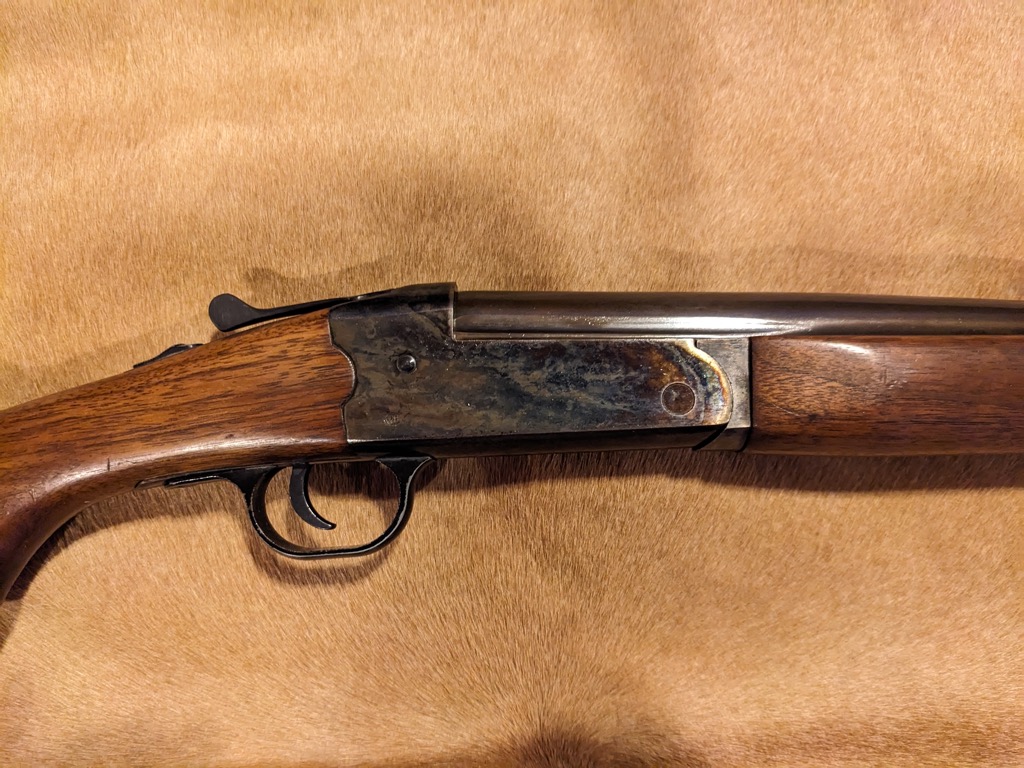
[1]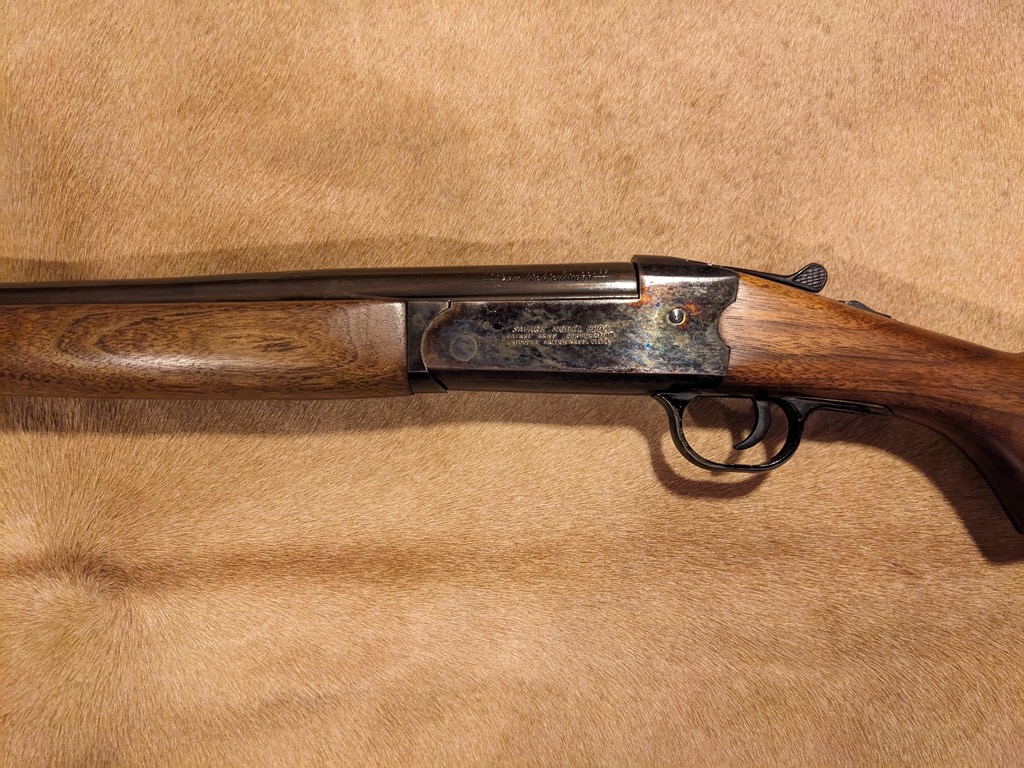 [2]The Savage Model 220A is a single-shot, break-action, hammerless shotgun with a tang safety. The finish on the 28-inch barrel appears to be slightly brown rather than blued, and the receiver appears to be case-hardened. The barrel has a 2¾ inch chamber and full choke. Sighting is through a groove at the top of the receiver to a bead at the front of the barrel. The barrel opens using a top lever located behind the tang safety. When the shotgun is broken open, the firearm cocks and the safety engages automatically.
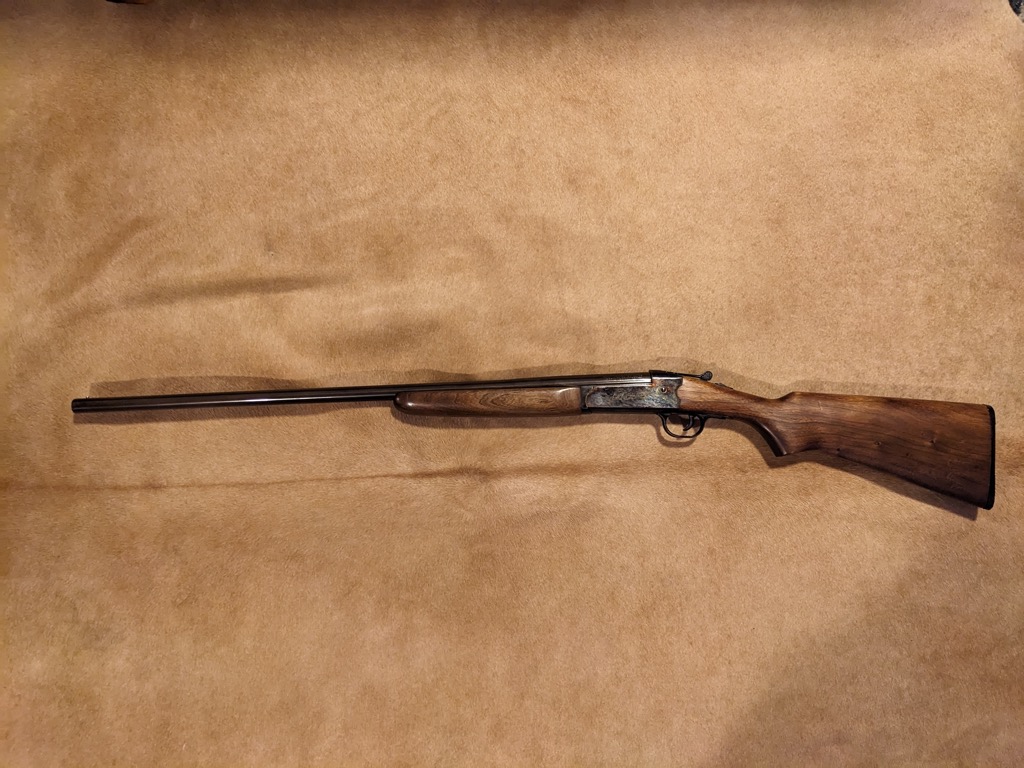 [3]The furniture is made of walnut. There is a hard plastic butt plate on the rear of the buttstock. The shotgun can be field stripped without any tools by simply pulling down the front of the forearm to remove it. Then the action can be broken open and the barrel lifted and removed from the receiver.
The Savage 220 was introduced in 1938. The 220A variant was produced from 1953 to 1964 in Chicopee Falls, Massachusetts. I am not sure exactly what year my 220A was manufactured. Like many other firearms manufactured prior to the Gun Control Act of 1968, it does not have a serial number. The bore is still as shiny and smooth as the day it came from the factory.
At about 6 pounds, the 220A is relatively light for a shotgun. That tends to make the felt recoil a little more noticeable than is typical for a 20 gauge.
The 220A was offered in 12, 16, 20, 28, gauges and .410. The barrels are interchangeable, but the forearm must correspond to the appropriately-sized barrel in order to fit correctly.
The receiver for the Savage 219 rifle was identical to the receiver for the 220A. The 219 came in .22 Hornet, 30-30, .25-20, and .32-20. It was possible to purchase the receiver paired with both a shotgun and a rifle barrel. That combination was called the “Savage Utility Gun.”
The 220A and the 219 were designed for sale to the “Blue Collar” market. They were really a nicer than average working man’s guns. Current prices continue to be reasonable. A look at Gunbroker.com revealed recent sales in the $77 to $470 range, with most sales in about the middle of that range.
Trigger Pull Weight
I tested the trigger pull weight of the 220A using a Ready Up Gear Digital Trigger Pull Weight Gauge. My five measurements ranged from a low of 2.29 pounds to a high of 4.81 pounds with an average of 3.48 pounds and a median of 3.46 pounds.
Pattern Testing
It was a gray afternoon in late January. The temperature was 10 degrees Fahrenheit. There was no wind. About a foot of powdery snow had collected during the snowfalls of recent days.
I made my way to the improvised range behind the pole barn. I set up a large piece of cardboard in front of the backstop on the range and then set up a table 15 yards away.
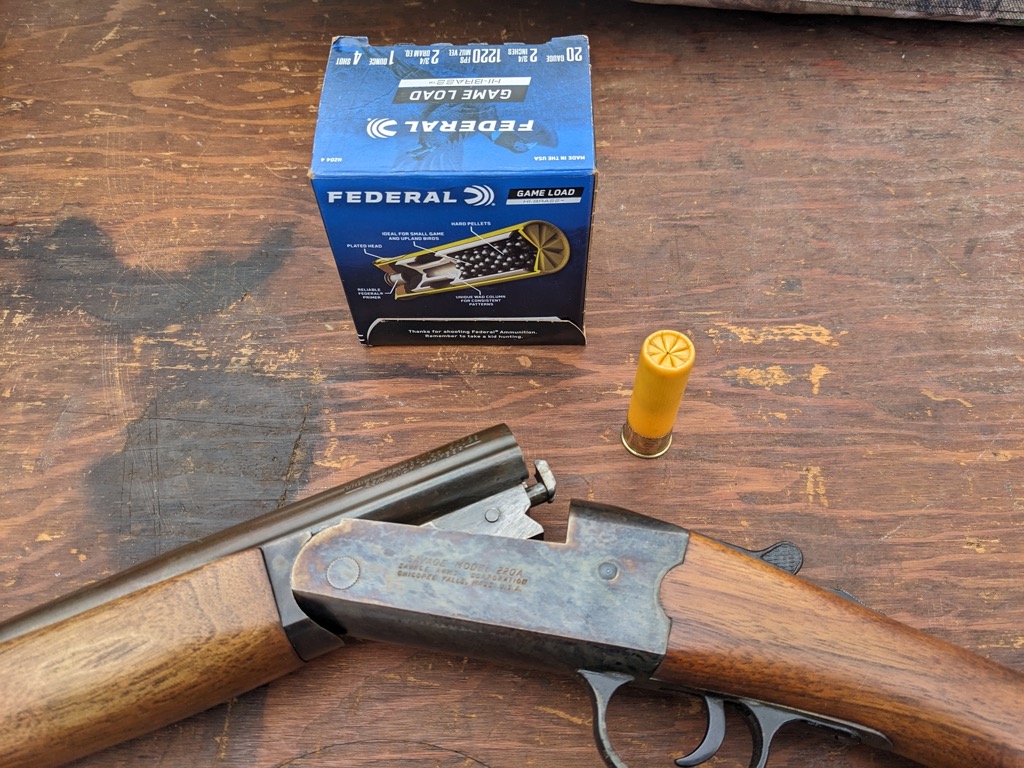 [4]I loaded a single round of Federal 2 ¾ inch, 1220FPS, 1-ounce, #4 shot and fired it at the cardboard. It produced a 13-inch pattern. This is similar to the 12-inch pattern predicted in Jack O’Connor’s classic 1961 book: Complete Book of Rifles and Shotguns. I was a little surprised, because modern shotshells often produce tighter patterns than those that were typical in O’Connor’s day.
Cleaning
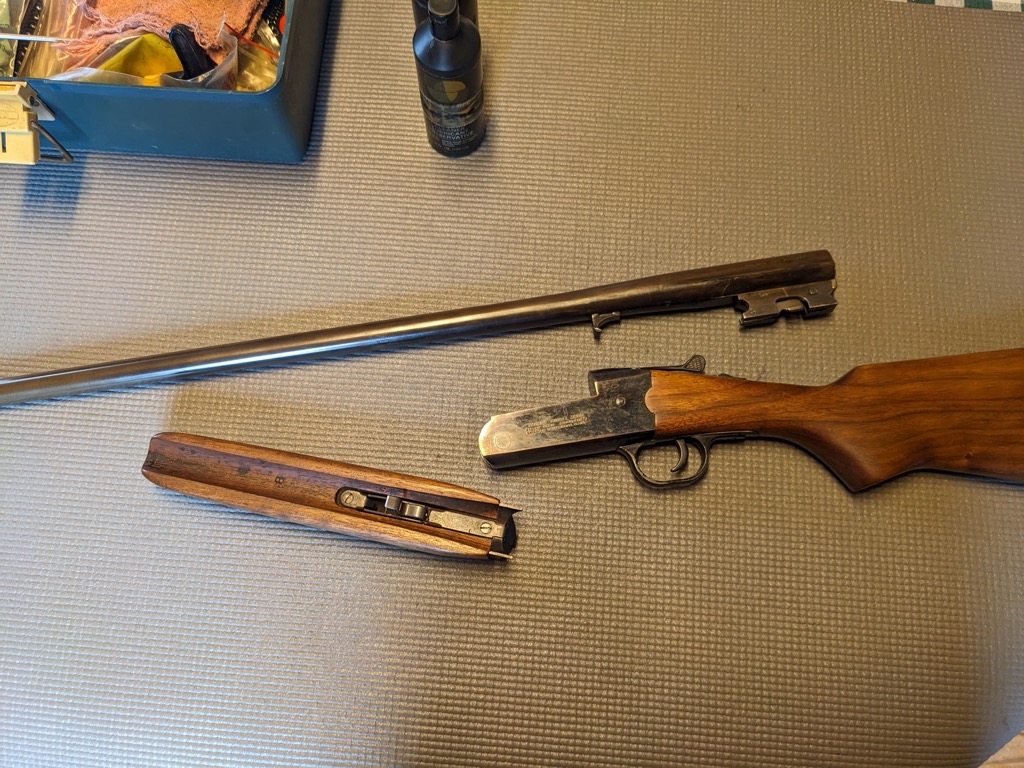 [5]The 220A is almost absurdly easy to clean. I simply field stripped the shotgun by pulling down on the forearm to separate it from the barrel and receiver. I then broke open the shotgun and then lifted the barrel clear. I ran a kerosene patch through the bore, and then scrubbed the bore with a brass brush. Then I ran another kerosene patch through the bore. I then wiped down all of the accessible metal surfaces with a kerosene patch. Next, I ran a dry patch through the bore and over all the accessible metal surfaces to remove excess kerosene. Then I ran a patch with Breakfree CLP through the bore and over all accessible metal surfaces. Finally, I reassembled the shotgun, touch up the light film of CLP over the external metal surfaces, and returned the 220A to the gun cabinet.
Some Savage Arms History
Savage Arms has a history of often being the bridesmaid rather than the bride. Their Model 1892 was a hammerless, lever-action, rotary magazine fed design that competed for an Army rifle contract and lost out to the Krag-Jørgensen. In the US Army trials for a .45 caliber semi-automatic pistol design, they were runner-up to the Colt M1911. Their attempt to provide a bolt-action rifle to supplement the M1903 Springfield in the run-up to the First World War lost out to the Pattern 1914 Enfield.
Savage took their lemons, and made lemonade. The Model 1892 matured into the iconic Savage 99. Their bolt-action design led to the development of the .300 Savage cartridge. They ended up producing the majority of the Thompson submachine guns that were used in World War II. They sold over a million units of their Model 24 combination gun. And the Savage 110 is the oldest continuously manufactured bolt-action rifle in America.
By the way, I love my Savage 110 Storm in 6.5 Creedmoor [6]. It is one of only two firearms that I have subsequently purchased after reviewing them for SurvivalBlog (The other is a Rock Island Armory MAPP FS). The accufit comb provides an outstanding cheek weld, and the accutrigger is outstanding. If I were buying a bolt-action deer rifle today, I would purchase either a Savage 110 Storm or a Ruger American Rifle Gen II in 6.5 Creedmoor. I like the comb on the Savage rifle a little more than the one on the Ruger, but find the finish on the Ruger to be a little more attractive. For me, both rifles shoot equally well.
Conclusions
The Savage 220A is a somewhat elegant rendition of the classic break-open shotgun design. The hammerless action, the self-setting tang safety, the brownish finish on the barrel and the case-hardening on the receiver are all nice refinements on the basic design.
For an application like home defense, some sort of repeating-action firearm may be preferable to a single-shot. But for applications like hunting or target shooting, the break-action provides an unusually durable and reliable design.
For me, the sentimental value of my Grandpa’s shotgun supersedes any practical considerations. May you also be blessed to own a few firearms that provide similar sentimental value.
Disclaimer
Ready Up Gear provided me with a sample of their Digital Trigger Pull Weight Gauge for a previous review. Savage loaned me a sample of their 110 Storm in 6.5 Creedmoor for an earlier review. I subsequently purchased the test sample. I did not receive any other financial or other inducement to mention any vendor, product, or service in this article.
JWR Adds: We have basicallly the same full-choke model 20 gauge as our primary garden and grouse gun, here at the Rawles Ranch. It is just like Tom’s, except that it was made with a woodgrain “Tenite” plastic stock and forend. With subcaliber chamber adapters, many single-shot shotguns can be quite versatile. Ours is an ejector model variant, and that makes it quite fast to reload. But, unfortunately, that also makes it incompatible with some subcaliber inserts, such as the famed Savage FourTenner.