A rifle chambered in 5.56 NATO probably offers the most widely available and varied selection of ammunition in America today. A quick visit to cheaperthandirt.com revealed a total of 144 different ammo options in a variety of bullet weights available in 5.56 NATO or .223 Remington at the time of this writing. These options also tended to be more economically priced than ammunition for other center fire rifle chamberings. Rifles chambered in 5.56 NATO also tend to produce negligible recoil and are generally light and easy to carry. Factors like these make rifles chambered in 5.56 NATO attractive options for a variety of uses such as varmint control and home defense.
The most common civilian rifle chambered in 5.56 NATO is the AR-15. But there are other exciting rifles chambered in 5.56 NATO that are not AR-pattern. The delightful Henry Lever Action Supreme in 5.56 NATO is one of these.
With gorgeous walnut furniture, a match-grade adjustable trigger, and the most butter-smooth action of any lever gun that I have ever handled, the Lever Action Supreme lives up to its name. As is appropriate for a rifle chambered in 5.56 NATO, the Lever Action Supreme accepts AR-15 magazines.
At the time of this writing, the Lever Action Supreme in 5.56 NATO had a manufacturer suggested retail price of $1,360. I highly recommend this outstanding firearm.
Background
I heard that Henry had developed a lever gun that accepts AR magazines. I strongly approve of cross-platform magazine standardization whenever it is possible. I like firearms chambered in 9mm that accept Glock magazines, firearms chambered in 7.62×39 that accept AK magazines, and firearms chambered in 5.56 NATO that accept AR magazines. This suggests that the firearm designer went the extra mile for the benefit of customers who might own multiple firearms chambered for the same cartridge.
Within about 30 seconds of hearing about the new Lever Action Supreme, I was contacting Henry Repeating Arms to see if they would loan me a sample for testing and evaluation. They were kind enough to agree. Eventually, I received a call from the gun store that handles my firearm transfers indicating that the Supreme had arrived.
First Impressions
The box that I picked up at the gun store contained a number of interesting items: the rifle in a plastic bag, an ammo inspection tag (showing that after the rifle was test fired, it was checked four times to make sure that it was clear of ammo), a registration card with an ad for henryoutfitters.com, a tag indicating that the rifle is “Made In America, Or Not Made At All”, the manual, a PMAG 10 AR/M4 magazine, and a plastic bag with a small allen wrench and a device for limiting the mag to 5 rounds.
I removed the rifle from the plastic bag. There was a warning sleeve around the barrel: “Warning. Inspect for ammunition first. DO NOT pull the trigger.” So I opened the action and inspected the chamber for ammunition. I am happy to report that I found it empty.
As I opened the action to inspect the chamber for ammunition, I was immediately impressed with how smoothly the lever operated. As in butter-smooth. The engineer who designed this action deserves an award for truly outstanding work.
As I mentioned above, the walnut furniture is gorgeous. In many ways, synthetic furniture is more practical, but synthetic furniture cannot hold a candle to a nicely finished walnut stock in terms of beauty.
The rifle has a nice, solid-rubber recoil pad. The negligible recoil produced by the 5.56 NATO cartridge makes that recoil pad largely unnecessary. Sling studs are conveniently preinstalled. The roomy lever leaves plenty of room for gloved fingers.
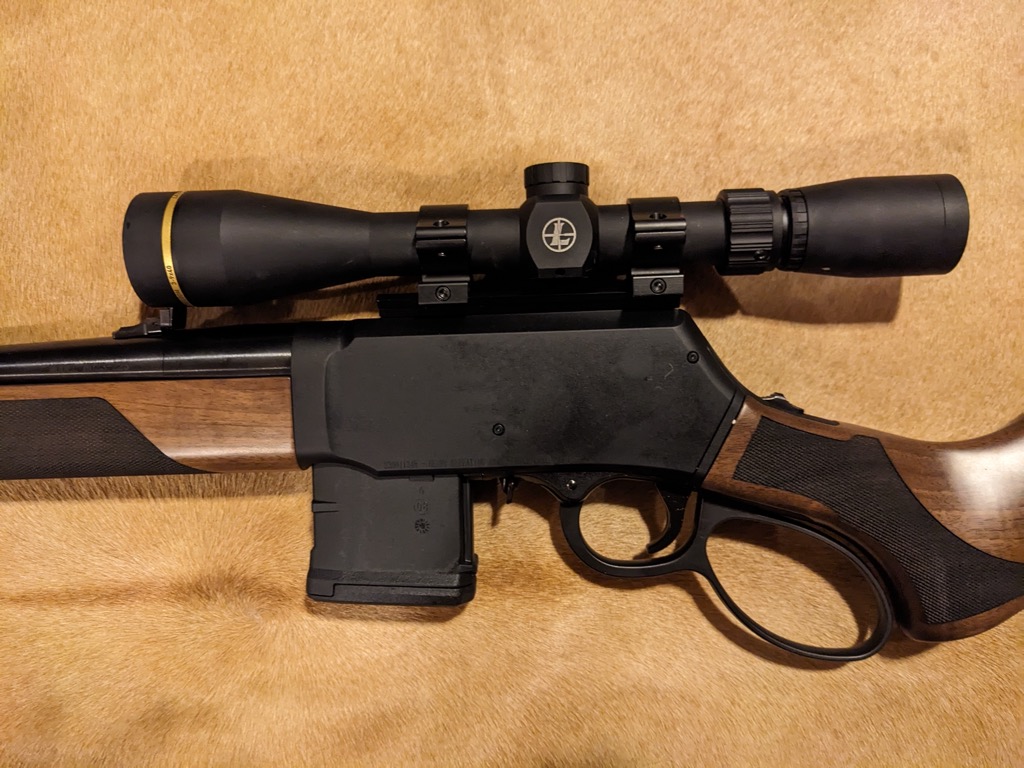 [1]The hard-anodized black finish on the receiver and the bluing on the barrel are well executed. The receiver is pre-tapped to accommodate a Weaver 63B scope base. The rifle comes with preinstalled iron sights. During my testing, I found the comb to be just a little too high for comfortable use with the iron sights, and just a little too low for a good cheek weld with a scope mounted. One of the few improvements that I can recommend to this fine rifle is an adjustable comb on the buttstock.
The magazine inserted easily and ejected smoothly when the release lever was pressed. It functioned very well throughout the testing process.
The 18-inch free-floated round barrel has the commonly used ½ X 28 threading in order to accommodate suppressors and other muzzle devices.
The Supreme has an overall length of about 38 inches and weighs in at only 6.65 pounds.
Reading the Manual
The manual is 36 pages long including the front and back covers. In includes a host of interesting information:
–I always appreciate the personal, 100% satisfaction guarantee from Anthony Imperato, CEO of Henry Repeating Arms: “I will do what it takes to make certain you are happy with your purchase.”
–The safe firearm handling guidelines are located appropriately near the beginning of the manual.
–The manual warns against the use of reloaded ammo.
–I am glad that the manual includes the following sound advice: “Henry RAC recommends that . . . you go to the range and fire different ammunition which is appropriate to the caliber of your firearm. Once you find the ammunition which functions best, keep using it.”
–They recommend cleaning the rifle prior to first use.
–They recommend the use of a cable-style cleaning kit to clean from the breech toward the muzzle. This advice is appropriate for most lever-action rifles. The Supreme, however, can be easily cleaned from the breech to the muzzle with a cleaning rod when disassembled in accord with the instructions in the manual.
–Instructions for adjusting the iron sights include references that seem clearly intended to be accompanied by illustrations. Those illustrations are missing. They were evidently edited out of the final draft of the manual. They should be edited back in.
–The manual includes good instructions for hangfire, failure to extract, and failure to feed.
–The rifle can be dry-fired without damaging it.
Preliminary Cleaning
Following the instructions in the manual, I cleaned the rifle using the following steps:
1. Opening the lever and removing the magazine.
2. Removing the two receiver pins with a punch and a rubber mallet. I then separated the two halves of the rifle.
3. Removing the firing pin retaining pin. Removing the firing pin from the bolt carrier.
4. Removing the cam pin from the top of the bolt carrier. Removing the bolt from the bolt carrier.
5. Pulling CLP swabs from the breech to the muzzle using the Otis FG-750 Tactical Cleaning System ( https://survivalblog.com/2025/02/17/otis-fg-750-tactical-cleaning-system-by-thomas-christianson/ ). I continued to pull swabs through the bore until one came through clean.
6. Pulling a brass brush through the bore.
7. Pulling a couple of more CLP swabs through the bore. Than a dry swab. Then one last CLP swab to leave a thin film of CLP on the inside of the bore.
8. Cleaning the firing pin, bolt, cam pin, bolt carrier, and all accessible metal surfaces with a CLP patch, leaving a thin film of CLP.
9. Reassembling the rifle.
The cleaning process revealed that the rifle has nice internal architecture, is well machined, and is a beautiful piece of workmanship overall.
I would feel a little better if the use of a punch was not essential to field stripping the rifle. We live in an imperfect world.
Trigger Pull Weight
I measured the trigger pull weight using a Ready Up Gear Digital Trigger Pull Gauge. My five measurements ranged from a low of 3.47 to a high of 4.43 pounds with an average of 3.92 and a median of 3.67 pounds.
Mounting a Scope
I ordered a Weaver 63B Scope Base. I was pleased to see that the base is made in the USA.
I went to the URL listed on the packaging for the base in order to view an instructional video. It was no longer present on the web. The written instructions that I was able to find online did not specify which of the two dissimilar pieces is the front and which is the back of the base. I finally decided that it probably did not matter, and that I had a 50/50 chance if it did.
I removed the dummy screws protecting the threads in the tapped holes on the top of the receiver. The tapped holes were drilled through steel inserts so that they would not strip out in the aluminum receiver. That is a nice touch. I stripped out one of the tapped holes in the top of my Ruger 10/22 because there were no steel inserts in the aluminum of that receiver.
I put the two pieces of the base in place and tightened all four mounting screws. I then installed Leupold Rifleman medium rings and a Leupold VX-Freedom 3-9X40mm Huntplex scope. I verified the eye relief, leveled the rifle and the scope, and tightened the rings evenly.
A close examination revealed that the front bell of the scope was touching the rear sight. I moved the scope back 0.75 inches to rectify this situation.
The comb was a little too low for an ideal cheek weld, but it was adequate. If I owned this rifle, I would probably install some sort of cheek riser.
At the Range
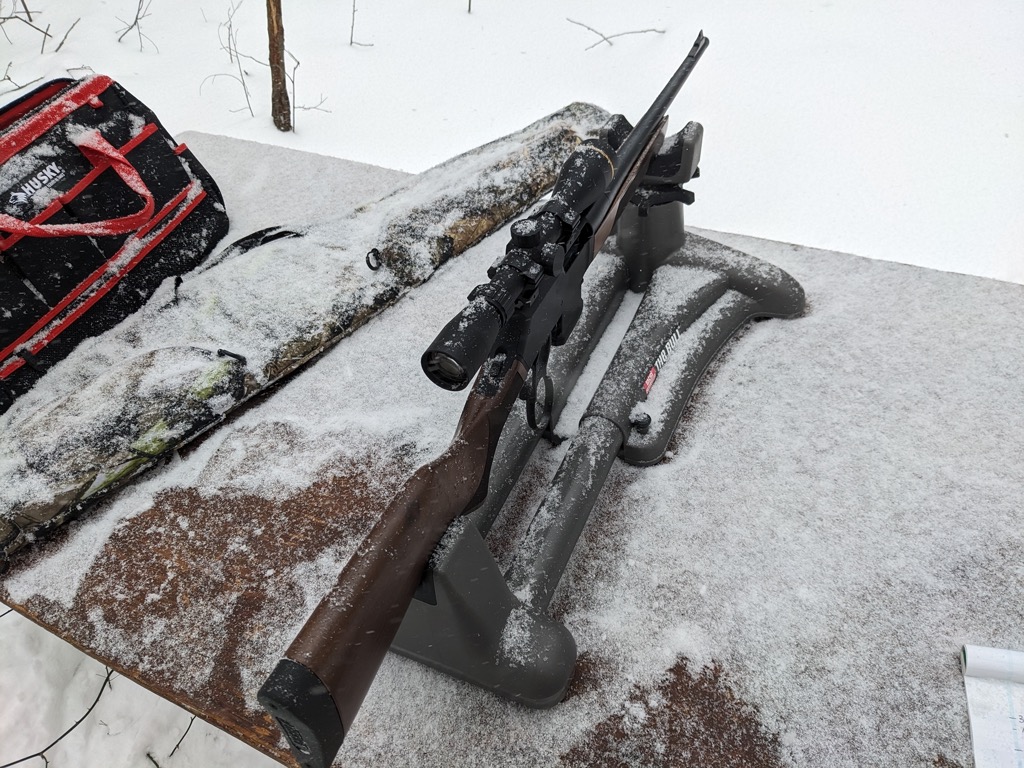 [2]It was the afternoon of New Year’s Day. A light snow was falling. The temperature was 22 degrees Fahrenheit. Six inches of powdery, new-fallen snow covered the ground. I put on some insulated canvas coveralls and made my way to the improvised range behind the pole barn. I put a target stand in front of the backstop on the range, set up a table 25 yards away, and placed a rifle rest on the table. Snow falling on my notepad made it difficult to write.
I loaded a single round of TulAmmo .223 Rem 62 grain FMJ Steel-Cased into the magazine. With a flick of the lever, the round chambered very smoothly. As I fired, the pleasant aroma of burnt powder wafted to my nostrils. The shot struck 1 inch high and 6 inches to the right of the point of aim.
Over the course of the next four shots, I adjusted the scope until the rifle was nicely zeroed. During the course of those shots, I noted that the action was butter smooth, the oversized lever functioned well with gloves, and that the magazine inserted and ejected well.
When the rifle was zeroed, I tried a three shot group. It was 0.65 inches in size.
I backed up to 50 yards. I fired three shot groups of the aforementioned TulAmmo, of Winchester Ballistic Slivertip .223 Rem 55 grain, and TulAmmo .223 Rem 75 grain HP. The groups produced by the 62 grain and 55 grain ammos each came in at 1.16 inches. The group produced by the 75 grain ammo was roughly twice as big at 2.28 inches. In addition, one of the rounds of the 75 grain ammo failed to fire in spite of a nicely dented primer. A second attempt with the same cartridge failed as well. A fresh cartridge was necessary to complete that group.
By this time the west wind and the snow were both picking up, and I was having problems with my own breath fogging my glasses. The south door of the barn iced up during the range session, and was difficult to close afterward. My range bag was full of snow, and the rifle case was covered in snow. The rifle, on the other hand, continued to function well.
Next, I turned to feed testing. I loaded the PMAG that came with the rifle with 10 rounds of TulAmmo .223 Rem 75 grain HP, and cycled the action rapidly. The rifle continued to feed smoothly.
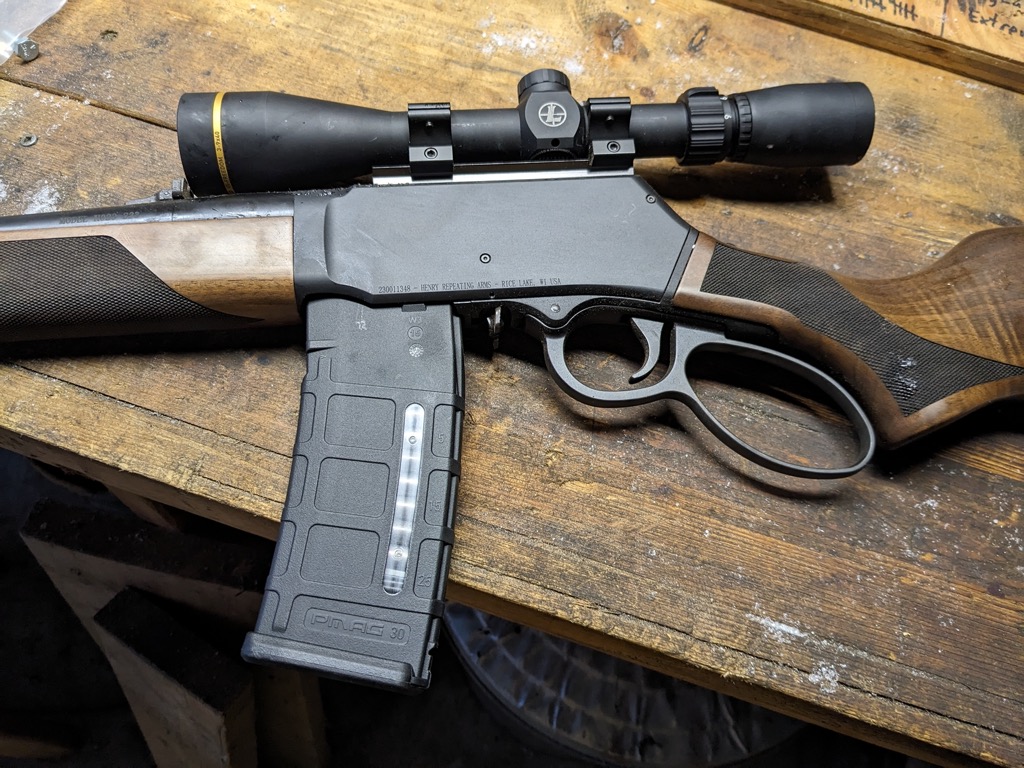 [3]Then I tried a 30-round Magpul PMAG30 Window. Because of the stronger spring, it was a little harder to fully seat the magazine in the magwell with the action closed. Cycling was also not quite as smooth until about halfway through the mag. But overall, performance was still smoother than any other lever-action rifle that I had ever used.
Finally, I tried a 30-round Lancer Steel/Polymer Hybrid magazine. As I cycled the action, the eleventh round was for some reason particularly difficult to feed. The other rounds fed fine.
I emptied the range bag and brushed down the rifle and the case to get rid of excess snow. Then I returned to the house for an exceptionally thorough final cleaning.
Final Cleaning
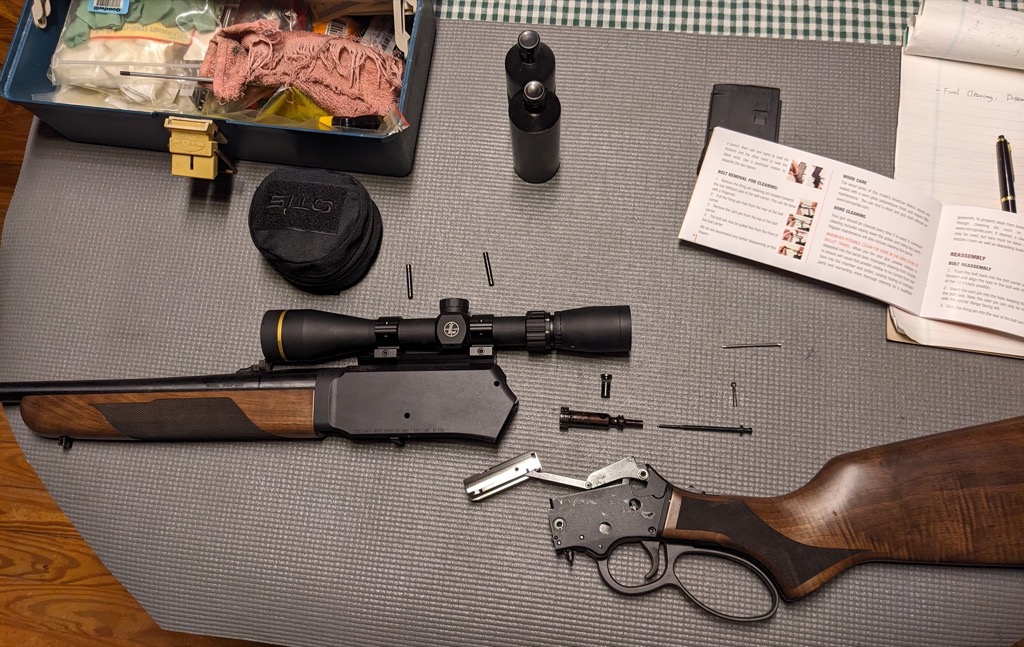 [4]I left the rifle in the case for a couple of hours to allow it to come to room temperature without accumulating condensation. I then disassembled it, and cleaned the bore from breech to muzzle using a cleaning rod. Other than using a rod rather than a cable, I followed the same process described in the preliminary cleaning above.
Conclusions
I was very impressed that the action of the Henry Lever Action Supreme was so smooth even while using steel-cased ammo under somewhat adverse weather conditions. Accuracy was well within acceptable parameters. The highly polished walnut stock continued to seemingly radiate a warm glow, while the bluing of the barrel maintained a deep luster.
If you have room in your gun safe for a rifle chambered in 5.56 NATO, this one would be an excellent choice.
Disclaimer
Henry Repeating Arms loaned me a sample of their Lever Action Supreme in 5.56 NATO for testing and evaluation. Otis Technology had provided me with a sample of their FG-750 Tactical Cleaning System for a previous review. Ready Up Gear had provided me with a sample of their Digital Trigger Pull Weight Gauge for a previous review. I tried not to allow the kindness of these vendors to interfere with my objectivity in this review, and I believe that I have succeeded. I did not receive any other financial or other inducement to mention any vendor, product, or service in this article.