Barrier blind ammo is designed to pass through common obstacles like car doors, windows, drywall, plywood, or heavy clothing without significant change to its terminal performance.
I recently tested G9 Defense Barrier Blind Hollow Point ammunition in 6.5 Creedmoor. I must admit that I was only secondarily interested in its barrier blind qualities. My primary interest was in the fact that the ammo is machine-turned out of solid copper. According to G9, this gives it greater consistency in density over traditional jacketed bullets. The lower standard deviation of ballistic coefficient, in turn, provides higher accuracy at extended ranges.
During my testing, I found the ammunition to compare favorably with my favorite ammunition in my favorite rifle in terms of accuracy. The results of my limited barrier penetration testing were more ambiguous.
A 20-round box of the ammo in 6.5 Creedmoor cost $58.99 at the time of this writing at g9defense.com . If you like to experiment with different ammo types to see if they can make your rifle just a little more accurate, then you may want to give this one a try.
Background
In September of 2024, SurvivalBlog published my review of G9 Defense 9mm External Hollow Point Personal Defense Ammo [1]. I was so impressed with the performance of that ammo in my testing that it has since been my preferred personal defense ammo.
I wondered if G9 Defense might have something that would work well in my Savage 110 Storm in 6.5 Creedmoor [2]. I contacted G9 Defense, and learned about their Barrier Blind Hollow Point in 6.5 Creedmoor. It sounded interesting, so I requested a sample for testing and evaluation. They were kind enough to agree. Not long afterward, a 7.5 x 6.5 x 3.5 inch shipping box arrived via UPS Ground.
First Impressions
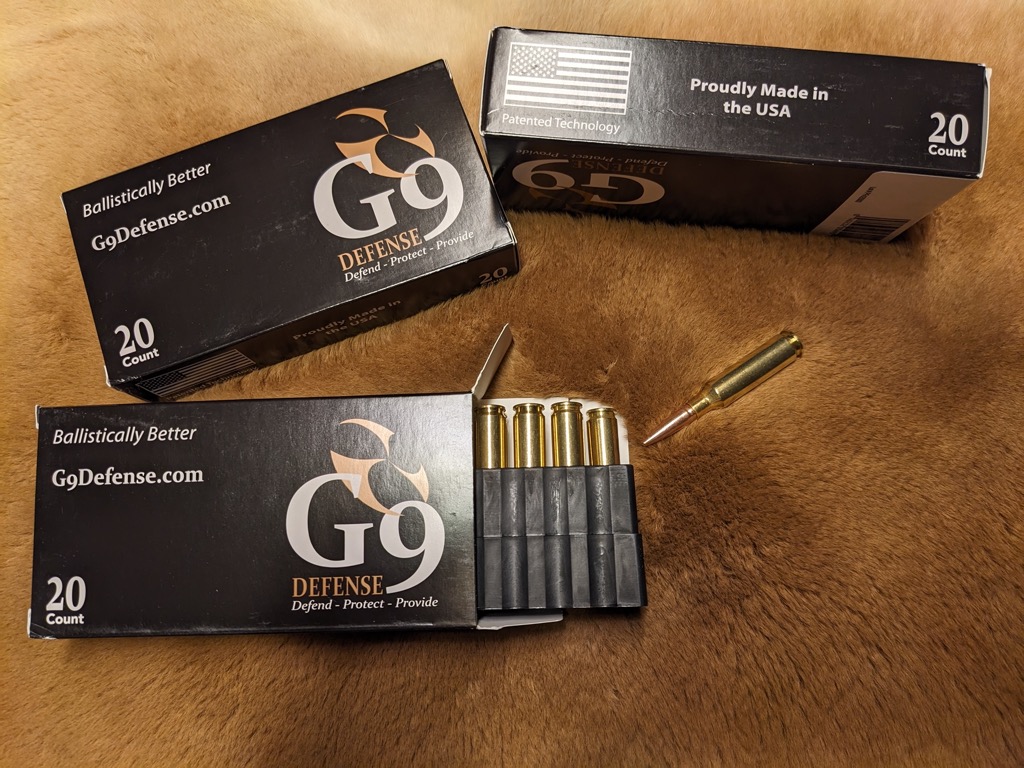 [3]The box came from G9 Defense, 4080 W Grange Ave., Post Falls, ID 83854. The box contained a packing list and three package boxes, each containing 20 rounds of the 120-grain solid copper barrier blind hollow points in 6.5 Creedmoor. The package boxes indicate that the ammo is “Proudly Made in the USA.” It also indicates that the ammo has a muzzle velocity of 2950 fps from a 24-inch barrel and that it has a G1 ballistic coefficient of 0.479.
The package boxes also noted that the ammo may not cycle properly in some semiautomatic rifles. Since my Savage 110 is bolt-action, I was not overly concerned about that piece of information.
Range Session One
It was an early afternoon in mid-autumn. The sun was shining somewhat feebly. The temperature was 45 degrees Fahrenheit. There was almost no breeze.
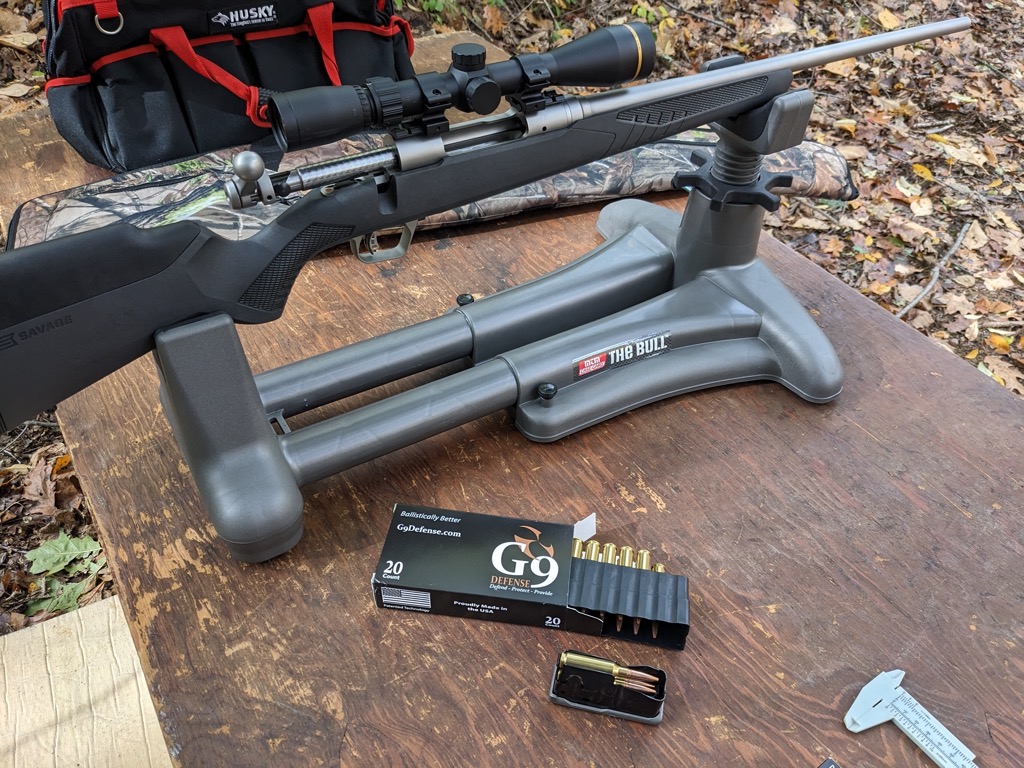 [4]I made my way to the improvised range behind the pole barn. I set up a target stand in front of the backstop and a table 25 yards away. I placed a rifle rest on the table. In the past, I have achieved the tightest groups with my 110 while using Sellier & Bellot 140 grain SP. So I loaded three rounds of that ammo into the magazine, and fired them at a target just to make sure that my zero was still good. They produced a 0.30 inch group that was slightly below the point of aim. The group was below the point of aim because the rifle is zeroed for 100 yards. At 25 yards the bullet is still below the line of sight.
Next, I loaded three rounds of the G9 Defense 120 grain Barrier Blind Hollow Point. The initial group with that ammo at 25 yards was 0.68 inches in size.
Then I moved the table back to 50 yards. From that range, the Sellier & Bellot ammo produced a 0.99 inch group while the G9 ammo produced a 0.62 inch group. The groups that I produce at 50 yards are often similar in size to the groups that I produce at 25 yards. This is probably at least partly due to the characteristics of the Leupold VX-Freedom 3-9X40mm Tri-MOA scope that is mounted on the rifle. The parallax-free distance of that scope is fixed at 150 yards. That makes groups fired at distances closer to 150 yards less prone to user error than groups fired at distances farther from 150 yards.
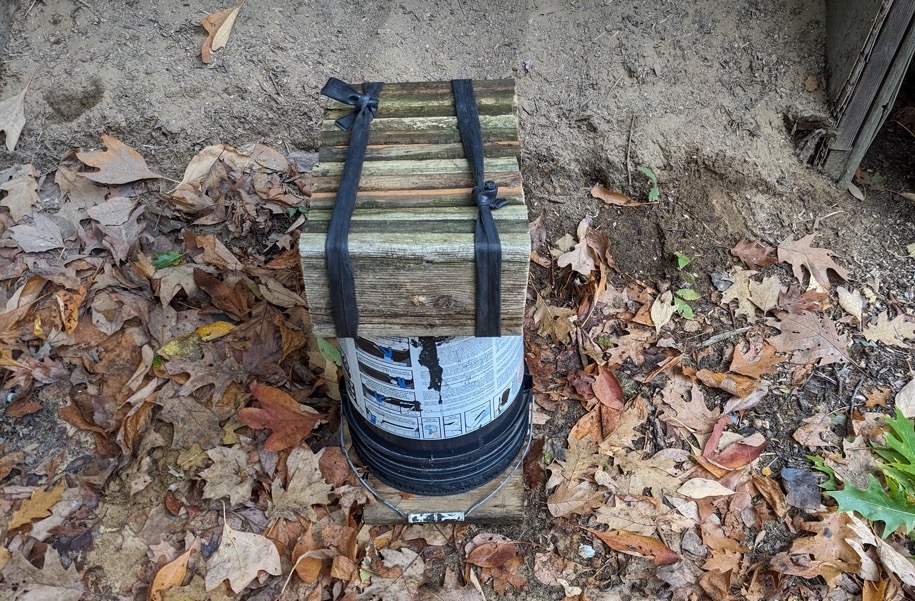 [5]Next, I took a dozen sections of old 2×6 house deck boards. Each section was 9 inches long, 1.13 inches thick, and 5.5 inches wide. I tied the sections together with two knotted lengths of bicycle inner tube. I then took this bound stack of deck boards and laid it on its side on top of a bucket in front of the backstop on the range. Then I fired one round of the Sellier & Bellot ammo into the left side of the stack, and one round of the G9 ammo into the right side of the stack. It was necessary to place the stack back on the bucket between shots, since each shot knocked it off the bucket.
 [6]
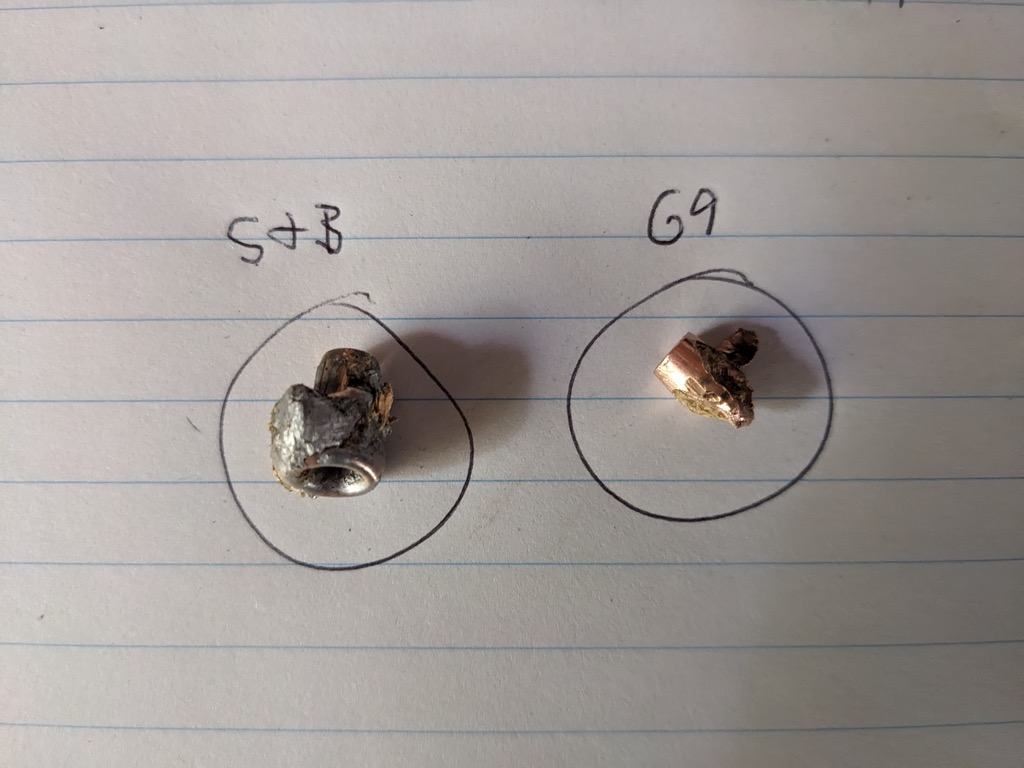
[6]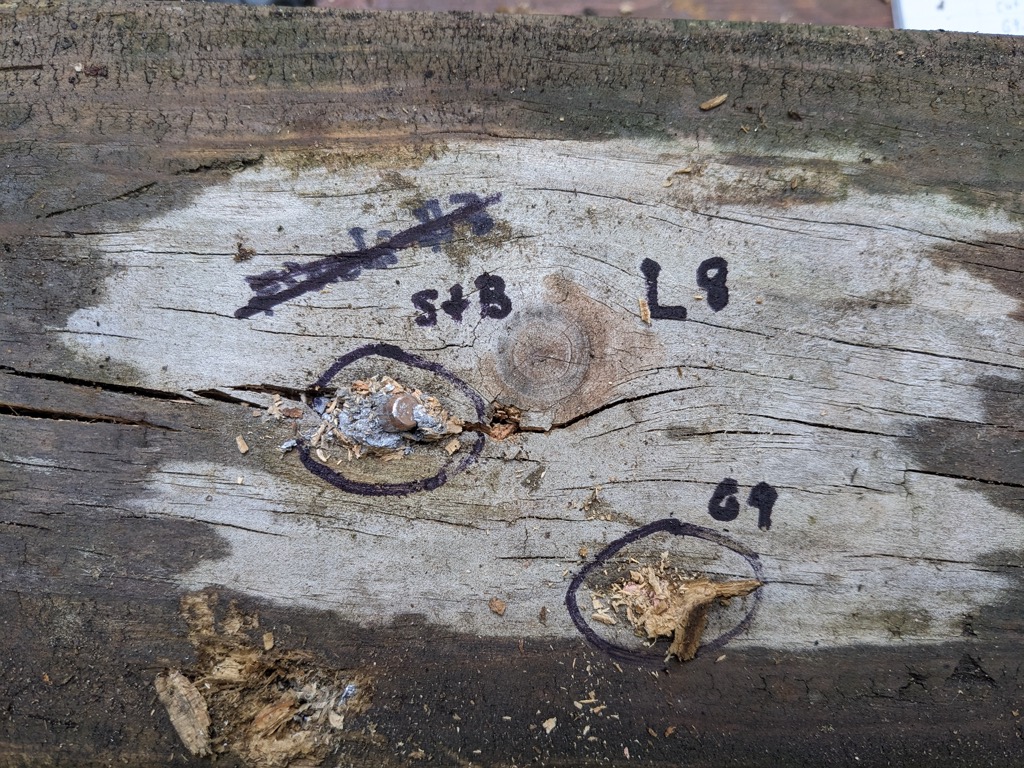 [7]The bullets from both ammos penetrated through seven layers of boards, and buried themselves in the eighth layer. The Sellier & Bellot bullet mushroomed well, created a significant “wound channel” through the various layers of board, and was recovered largely intact from the eighth layer of board. The G9 bullet was not designed to mushroom, so it left a much smaller “wound channel”. It was also significantly diminished in size by the time it came to rest in the eighth layer of board. So the copper solid did not penetrate any further than the traditional jacketed bullet, and did not retain its structural integrity as well as the S&B projectile.
Range Session Two
It was the Thursday before Thanksgiving. I took the G9 ammo and the Savage 110 to the 100-yard indoor range of my local rod and gun club. The place was packed with shooters. I needed to wait for about 20 minutes or so for a lane to open up. The range officer jokingly said that everyone who missed a deer during hunting season had come that night to find out what was wrong with their rifle.
I fired a number of three-shot groups with the G9 ammo. The groups ranged in size from 1.37 to 2.62 inches with an average of 1.87 inches and a median of 1.62 inches.
I also fired a number of three-shot groups with Nosler Whitetail Country 140 grain Solid Base Softpoint. The groups ranged in size from 0.74 to 1.62 inches with an average of 1.2 inches and a median of 1.24.
One of my three-shot groups with the Nosler ammo came back with six holes in the paper. The guy in the lane next to mine accidentally shot my target. Fortunately, he was shooting 5.56, so it was easy to distinguish his hits from my own.
It was nice to get out with the Savage 110 again. Every time I use it, I like it better.
Both the G9 and the Nosler ammunition performed well, but the Nosler ammo performed slightly better. Of course, in one rifle, Ammo A will outperform Ammo B, while in another rifle ammo B will outperform ammo A. Both the G9 and the Nosler ammunition performed well enough that I would be thrilled to have a lifetime supply of either. The primary obstacle to better rifle marksmanship that I face is the guy behind the scope, not the ammo that I use.
About G9 Defense
G9 Defense was founded by Joshua Mahnke to manufacture and market his new bullet designs. Joshua’s interest in bullet design began when he was placed in charge of his church’s security team. After extensive research on existing bullet designs, he began looking for something more effective using copper and brass solids. He tested his early designs on the end of an arrow from a compound bow in his backyard. His research ultimately led to 51 newly patented bullet designs.
Conclusions
Based upon my limited testing, G9 Defense 120 grain Barrier Blind Hollow Point in 6.5 Creedmoor is reasonably accurate. But it does not seem to offer superior penetration or weight retention while penetrating wooden boards.
So, for precision shooting, I plan to continue further testing of the G9 ammo. But for hunting and similar uses, I will probably favor either the Sellier & Bellot 140-grain Softpoint or the Nosler Whitetail Country 140-grain Solid Base Softpoint. I need to do some additional testing comparing those two ammuntion types before coming to a final decision.
Disclaimer
G9 Defense provided me with a sample of their 120-grain Barrier Blind Hollow Point ammo for testing and evaluation. They had provided me with a sample of their 9mm External Hollow Point Personal Defense Ammo for an earlier review. Savage Arms had loaned me a sample of their Model 110 Storm in 6.5 Creedmoor for an earlier review. I subsequently purchased that test sample. Nosler provided me with a sample of their Whitetail Country 140-grain Solid Base Softpoint for testing and evaluation for a future review. I tried not to allow the kindness of these vendors to interfere with my objectivity in this review, and I believe that I have succeeded. I did not receive any other financial or other inducement to mention any vendor, product, or service in this article.
About The Author
Thomas Christianson is a long-time contributor to SurvivalBlog, who became a paid Field Gear Editor. He previously wrote articles under the pen name “The Novice.”
His motto as Field Gear Editor is taken from 1 Thessalonians 5:21: “Prove all things; hold fast that which is good.”
Tom grew up in a small town in a semi-rural area in the Midwest, where everyone was acutely aware that food came from a farm before it ever came from a grocery store. He learned gun safety in school, and on the first day of hunting season, all the young men were absent from school.
He began writing as a stringer for a local newspaper while still in high school, and has enjoyed writing ever since.
After college and seminary, he and his wife spent a decade overseas as missionaries. They returned to his hometown where he joined the staff of his sending church. One of his responsibilities there is to care for their missionaries. He often has opportunities to test field gear while on trips to work with missionaries.