(Continued from Part 1.)
Power
Most remote homes and lodges rely on generators. The problem with generators is that they are noisy and smelly. So many people build a ventilated shed around them to buffer the noise. I appreciate that! In our case, we built the power tower (for the wind turbine, solar panels, antennas, and satellite dish) and power shed on the highest point on our property, so the 120 foot tower rises above the tallest trees, 400 feet east of the cabin. When we use the small generator as supplemental power, on rainy, snowy, still days, I am grateful that I do not have to listen to it, in part because it is so far away, and in part because the engine is angled east -away from us.
Unfortunately, because of that distance, we had to dig a 400 foot trench for the electrical wires from the power shed to the cabin, by hand, on our hands and knees through thousands of roots. That was tiring and uncomfortable work. We had similar issues with other buildings in which we wanted electricity, but by that time, we had bought a small backhoe that we can tow behind our ATV, which quickly dug the trenches.
Readers who are planning off-grid properties can consider what to do to reduce sound and pollution of any petroleum-powered power sources. In my view, why do you want to live in a lovely remote place and hear an engine?
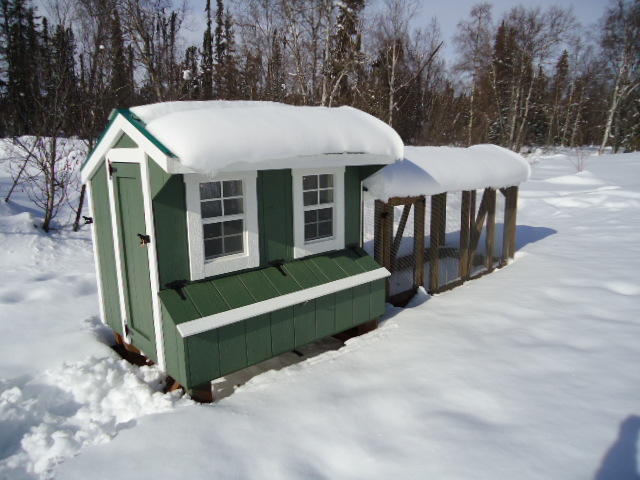 [1]On a related topic, we should have positioned our electrified buildings together for shorter wires and greater efficiency. For example, I would have put the chicken coop (pictured at left) and rabbit hutch building adjacent to one another. They have similar issues of food, water, heat. I made the mistake of loving to see the free ranging chickens, so I put their coop about 80 feet from our home, which required another trench for electricity and a dead-end, hard-packed path on top of the snow to care for them in the winter.
The solar panels have been maintenance-free and effective for 15 years. Four panels are stationary on the power tower and face south. Six more we hung on a rotating post that can pivot east or west in the summer. The wind turbine was damaged by excessive wind the very first winter, stripping some bushings, but it still worked for a decade. Then we replaced it with one that is quieter and more effective because its design allows the blades to tip up or down with the wind as well as rotate, so it generates more power in less time. We need to replace the battery bank every 7 or 8 years. Last time, that cost about $3,000. We top off the cells with distilled water, quarterly.
Buildings
In any climate, the orientation of the seasonal winds, the arc of the sun, temperature ranges, and the amount of sun, rain, snow, and salt water should determine appropriate construction design, materials, roof pitch, length of eaves, and location of windows and doors. This is particularly important in an off-grid location, where a resident wants to reduce utility costs (or have none) and will likely rely on passive systems of ventilation, light, heat, shade, and cooling.
Roof Designs
In climates with heavy snowfall, steeply-pitched roofs are maintenance-free. A few of our earliest buildings, like the first outhouse, chicken coop, and wash house, have shallower roofs. This was a mistake, because they require shoveling to reduce snow weight.
Most of our roofs slope toward the north and south. The southern side tends to shed snow first, as the snow and metal warm in the sun. The snow that falls forms a berm that insulates the haskaps and apple trees that grow next to the warm, southern wall. The north facing roof takes the brunt of the wind.
In our part of Alaska, the prevailing wind is from the north in winter, so that is the direction from which the snow drives, too. Most of our buildings face west (toward the lake), with doors opening east and west. The doors to our main cabin open inward, so we will never be blocked inside by excessive snow accumulation outside. (It can top 8 feet). Our upstairs, covered deck is protected from snow in the winter by a seasonal plastic panel on the north side.
Any off-grid cabin in a cold climate will have a chimney. For contemporary buildings, that is usually a metal tube that is lightweight enough that it can be damaged by snow weight or wind. Our chimney rises up alongside the east side of the building, so it is protected from both. However, chimneys that rise out of a sloping roof up here often have an upside down V shaped flange screwed into the roof above and alongside the tube to divert the snow. In windy locations, these chimneys are tied to the edges of the roof with several stout wires.
Insulation
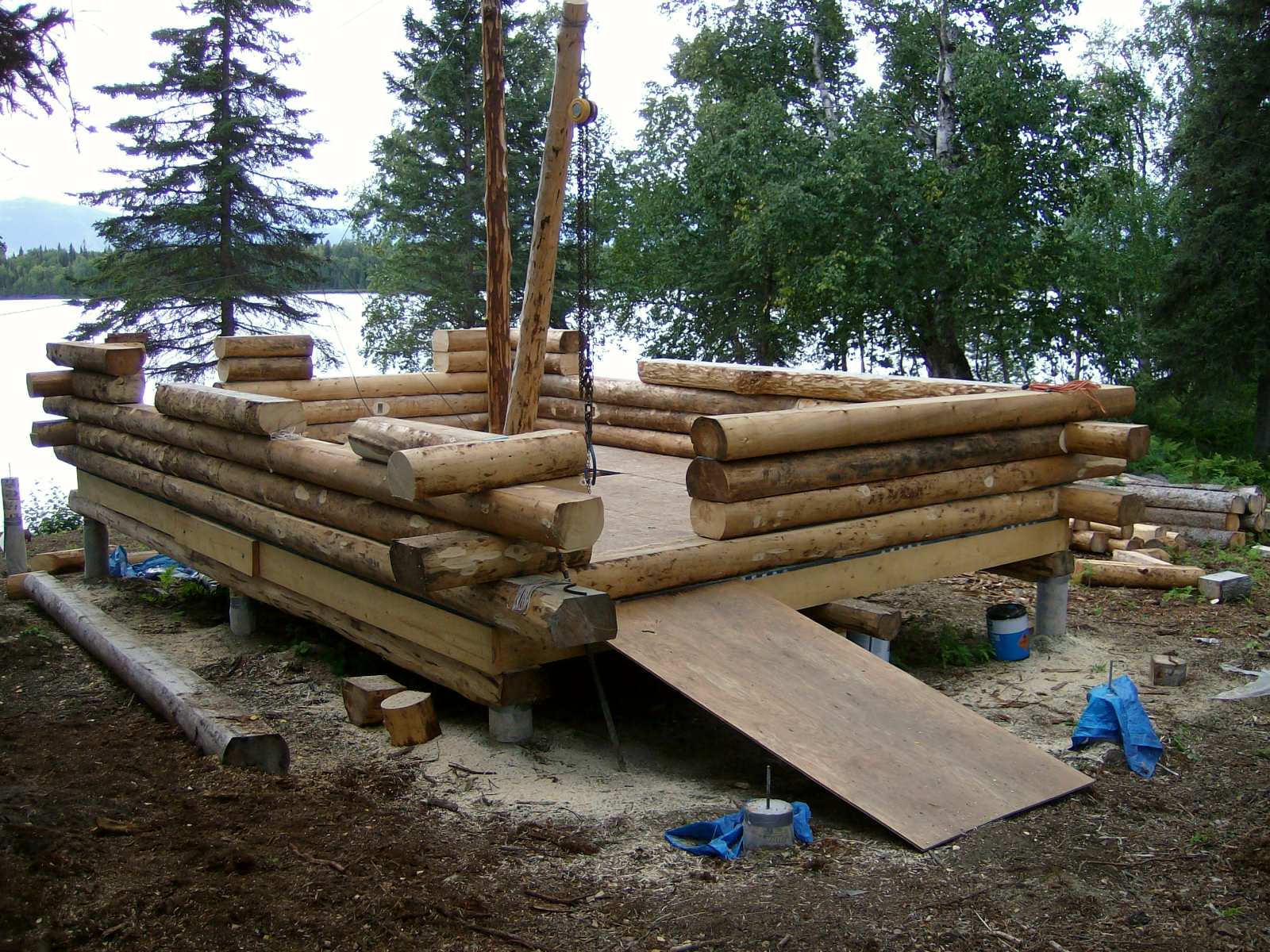 [2]Our main cabin was built of spruce logs 14 to 17 inches thick. The logs are the insulation. We have no sheetrocked interior walls over vertical insulation like we do in our woodframe guest cabin. The only insulation in the walls of our cabin are thin polystyrene sheets between the logs and tufts of fiberglass wool that I jammed into drafty nooks and crannies. The floor and ceiling are insulated with 4-inch-thick polystyrene panels. In winter, the floors are covered with lots of rugs, but in summer I roll them up for easier sweeping. The windows are double-paned, but in addition, on winter nights we cover them with well-fitting sheets of quilted silver mylar sheet insulation, which are quite effective.
Previously, I hung wool blankets over the windows (folded over rebar held up with cup hooks behind the curtains. Both of these methods would also work for insulating sunny windows in extremely hot locations.
Of course, we have no air conditioning. On the occasional hot summer day (over 75 degrees), I keep the southern window curtains closed to shade the interior, and/or install square window fans (super cheap) on both the north and south windows, to blow hot air through and out the opposite side. On the front porch, I roll down bamboo – like shades on the south and western sides. This not only shades us when we eat dinner there, it also keeps the sun from reaching and warming the logs on the front of the cabin and penetrating the large picture window.
Alternatively, in winter, the low sun warms the log walls, creating a micro-climate that is 10 – 20 degrees warmer than away from the building. We can enjoy outdoor meals at 35-40 degrees if the sun is hitting the building.
Ventilation
Upstairs, our windows and sliding glass doors open east/west. Downstairs, our windows open north/south. Since the structure is a simple, two-story building with central spiral stairs, the cross ventilation is excellent. We did not pierce a log in the kitchen to install a fan over the stove, and sometimes I wish I had one. In summer, though, my windows are always open. In winter, sometimes the cabin smells like burned rice! This year, I bought a plug-in air monitor that measures particulate matter of various sizes, as well as volatile organics. I was concerned about ash and smoke when we open and close the woodstove every few hours. To my surprise, the air monitor does not spike then. Rather, it spikes when I fry bacon or chicken. Except for those tasty treats, our air is pristine.
One mistake we made was the position of the front door and picture window. We are so far north that the sun travels about 2/3 of the sky in the summer and 1/3 of the sky in winter. We should have put the wooden door on the northwest side and the big picture window on the southwest side to bring in more winter sun. One wise piece of advice we followed was installing picture windows that do not open facing the front and back porches. Why? We do not want bears to have any latch or glider to slide or tear open for entry. We have certainly seen the damage they do to cabins they access!
Heating
Obviously, in Alaska, a well-heated home is a necessity, but that heat can be expensive, either on grid or off. In tundra locations or in regions like the Dakotas and southern Idaho without many trees, people dug homes below ground, reserving precious wood to support a sod roof. Many remote cabins are heated by fuel oil stoves. Our guest cabin and wash house have on-demand heaters powered by propane. But these heaters are demanding. If the guest cabin heater is put on the coolest level (1), a 100 lb propane tank lasts only one month. So, since we live in a forest, we heat our home with a small, efficient woodstove for which we cut about 11 cords of firewood in the woods. This exertion gives us good exercise on winter days.
On top of the stove are two small, passive metal fans that turn as the heat of the stove rises. These “push” hot air out into the room.
The importance of heat and the labor needed to cut, haul, and store fiewood helped us decide to build a small, simple main cabin that is easy to heat, with less wood. As a result, many rooms that you might have in your home, we do not have at all because we do not want to heat them. For example, we have no hallways, closets, laundry room, food pantry, second bedroom, or even bathroom inside. We don’t even have a refrigerator or freezer in the kitchen. (So the house is blissfully silent). These large appliances and rooms are all in separate buildings, most of which we do not heat (and of course, we do not power the fridge or freezer all winter). Our wood-fired bathtub is on the back deck. By stripping all these functions and square footage out of the house, our 16 x 32 x 2 floors interior (750 sq ft) has more room for our needs than one might think.
Downstairs, west of the spiral staircase, we have a living area with two loveseats, a chair, bookcase and a front entrance. South of the stairs is our kitchen table. East is the kitchen, wood stove and wood stack and back entrance. Upstairs, we have a queen-size bed, a seating/exercise area, two hobby areas (one for ham radio and one for sewing or keyboard), two long bookcases and five dressers/storage cabinets. This open design heats well, although the farthest corners from the woodstove are cooler. If somebody designed an interior floor plan with doors and corridors, it would be more challenging to heat evenly from a single source. Obviously, a larger home would require much more time and storage for wood fuel. One friend has a 5-bedroom home for which he needs 40 cords of wood each winter. Another, with an attractive, two-story living area, loses a lot of heat to the second story, where the upstairs bedrooms get hot while the downstairs remains cool. That sort of design is pretty, but more expensive and less efficient to heat.
(To be concluded tomorrow, in Part 3.)