The M3 Fighting Knife was designed with a single purpose: to kill the enemy. It was designed to penetrate deeply into an opponent during hand-to-hand combat, severing arteries and veins along the way, so that the opponent would quickly lose enough blood to cease to be a threat.
The M3 and the KA-BAR were evaluated together for the US military in 1942 by civilians on the Smaller War Plants Corporation Board. It was adopted by that board based on civilian rather than military criteria. The chairman of that board was eager to select designs that could be quickly and economically produced by small businesses, thus allowing private industry to more smoothly reconvert to peacetime goods production after the war.
Unlike the dual-purpose KA-BAR, the M3 is not particularly effective at prying open ammo crates, opening cans, batoning firewood, or a host of other tasks that call for a knife in the field. As a result, soldiers who were issued the M3 were not as well served by the knife as they would have been served by a more utilitarian design like the KA-BAR.
Since I so rarely have occasion to kill anyone or anything, I was happily unable to test the M3 for its intended purpose. If I ever need to slaughter a pig or a cow, the knife will likely do an excellent job of bleeding out the future pork chops or ground round. In the meantime, my M3 serves primarily as an interesting historical artifact.
 [1]
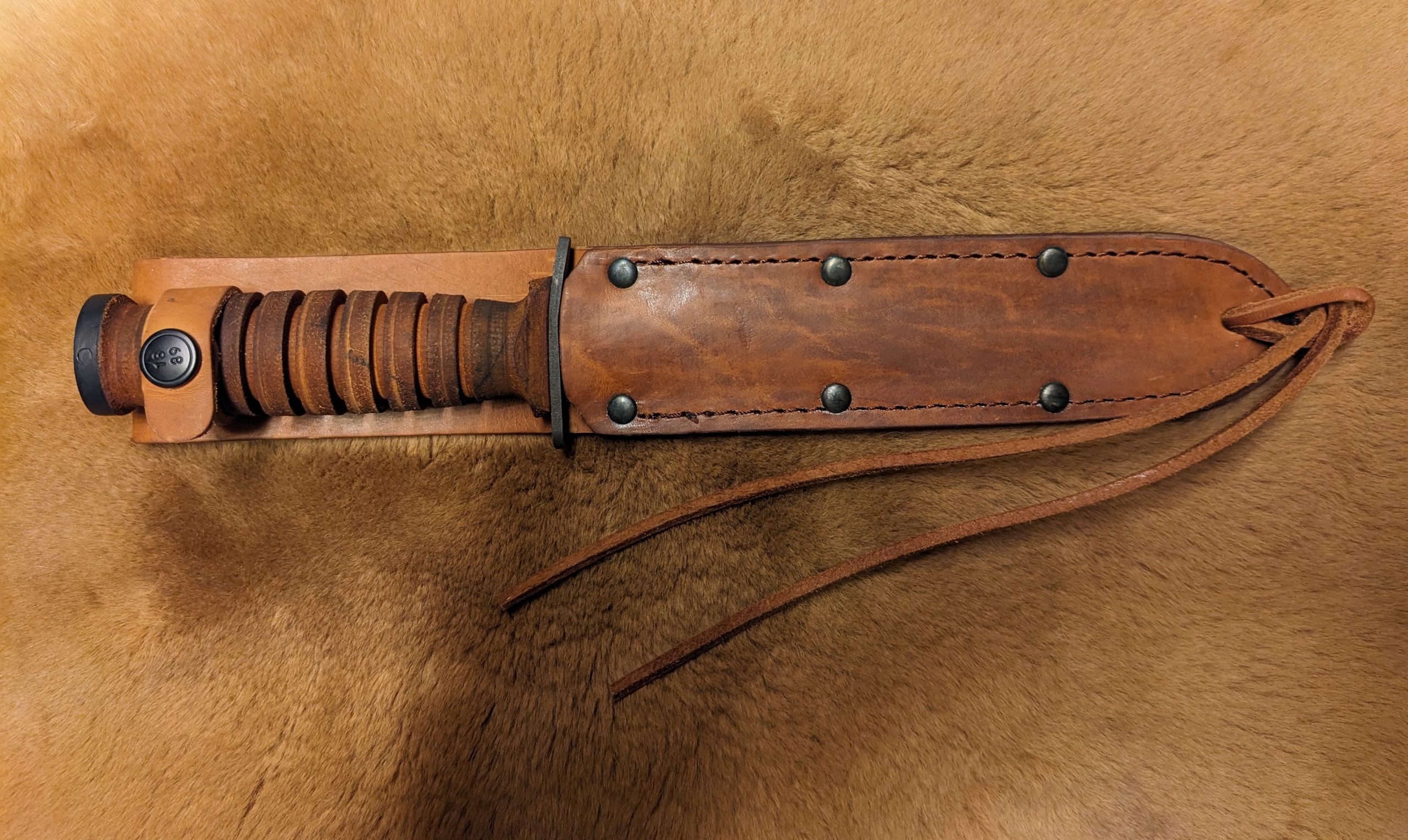
[1]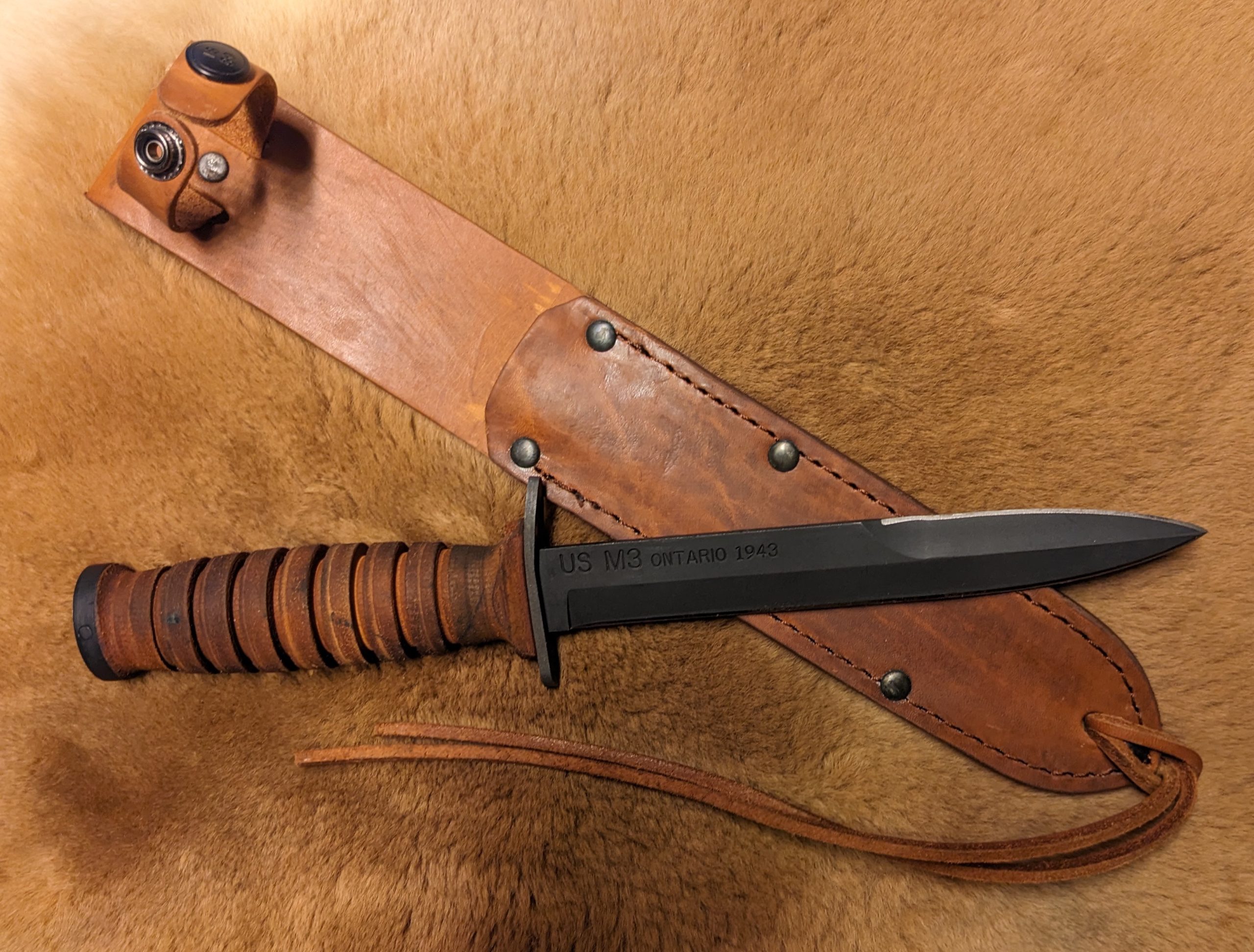 [2]If you are like me and enjoy historical artifacts, the M3 is a thing of beauty. It has a 6.75 inch, parkerized, carbon steel blade that is 0.94 inches wide at the base of the spine and 0.13 inches thick. The leather sheath is well-stitched, rivet-reinforced, and is made of a heavy gauge of fragrant leather. The handle is made of stacked leather washers that provide a comfortable and effective grip surface. My M3 comes from the inventory of Elk Creek Company [3], where it cost $55 at the time when I received it as a gift from SurvivalBlog Senior Editor James Wesley, Rawles (JWR). (Full Disclosure: Elk Creek Company is owned by JWR).
If you would like to own a field knife for practical use, I recommend the Cold Steel Leatherneck SF [4] instead. It is a nice update to the Marine KA-BAR “Knife, Fighting Utility” of World War II fame. Its D2 steel is more corrosion-resistant than the original carbon steel, and the rubber-like Kray-Ex handle is more rot-resistant than stacked leather washers.
Although the M3 is not my favorite field knife for practical use, it is infinitely superior to the Glock FM78 and FM81 Field Knives [5]. The soldiers of the Austrian Army have the misfortune to be equipped with Glock field knives to this day. The blade is awkward and too thin for most practical tasks, and the noisy polymer sheath makes stealth virtually impossible for anyone carrying the knife. I own an FM81 that I have been trying to give away to family members and friends for two years now without success. This proves that my family and friends have discriminating good taste (in knives, at least, if not in friends and relatives). I am thankful that Glock handguns are better than Glock knives.
By the way, the M3 may not be legal to carry in all jurisdictions. The 3.5 inch sharpened backswedge may cause it to be classified as a dagger. Daggers are illegal to carry in some places.
Sharpening
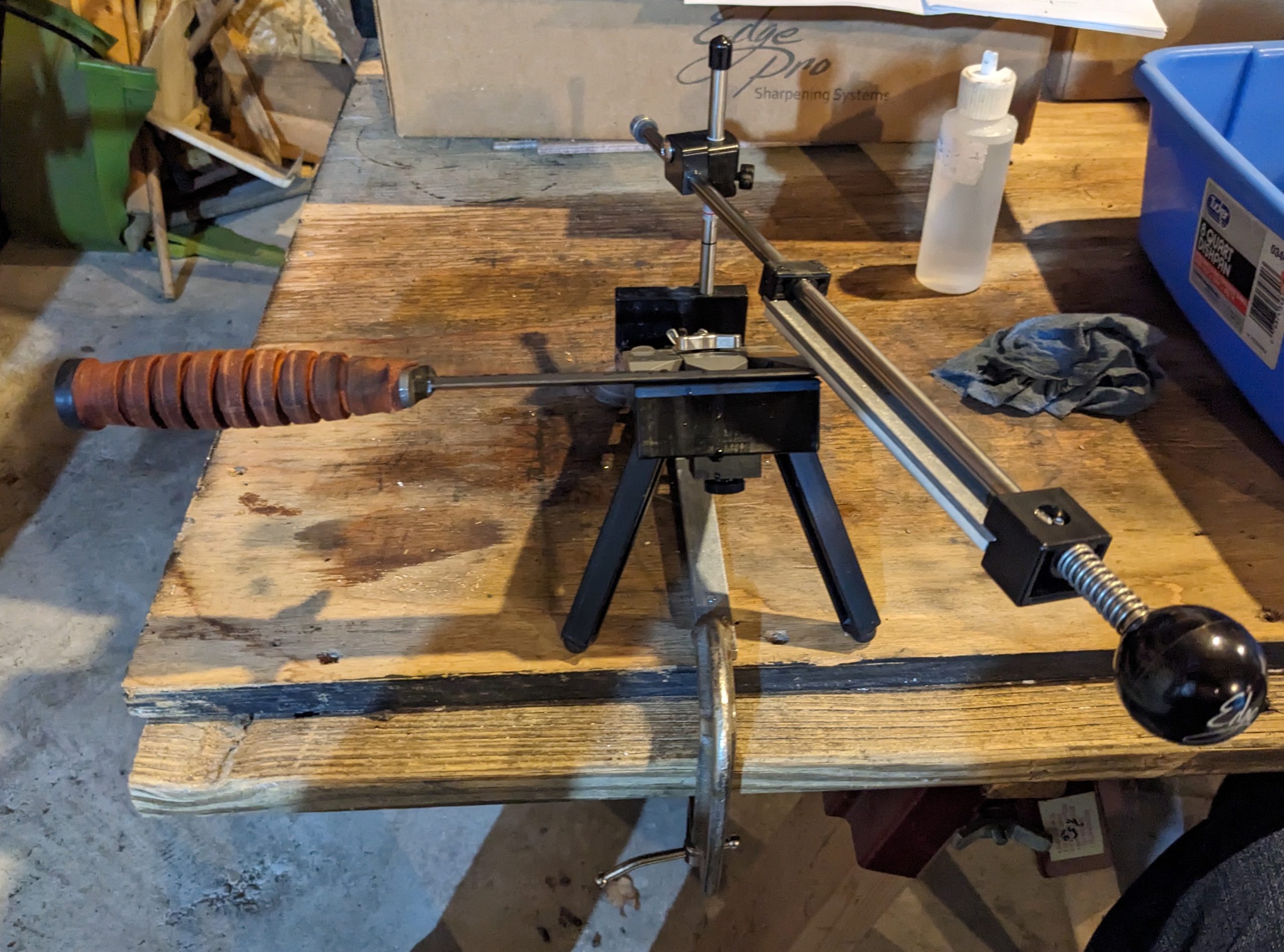 [6]The M3 came out of the box less than shaving sharp. The carbon steel blade was so hard that a single session with the AccuSharp Diamond Pro 2-Step Knife Sharpener was not sufficient to make it shaving sharp. The second, third, and fourth sessions with the AccuSharp were likewise unsuccessful. I then took the knife out to the pole barn for a session with the EdgePro Apex Sharpening System. An initial one-hour session improved the edge, but it was still not shaving sharp. After a second session, the edge was getting close, but was still not quite there yet. After a third session, the blade was finally, just barely shaving sharp.
M3 History
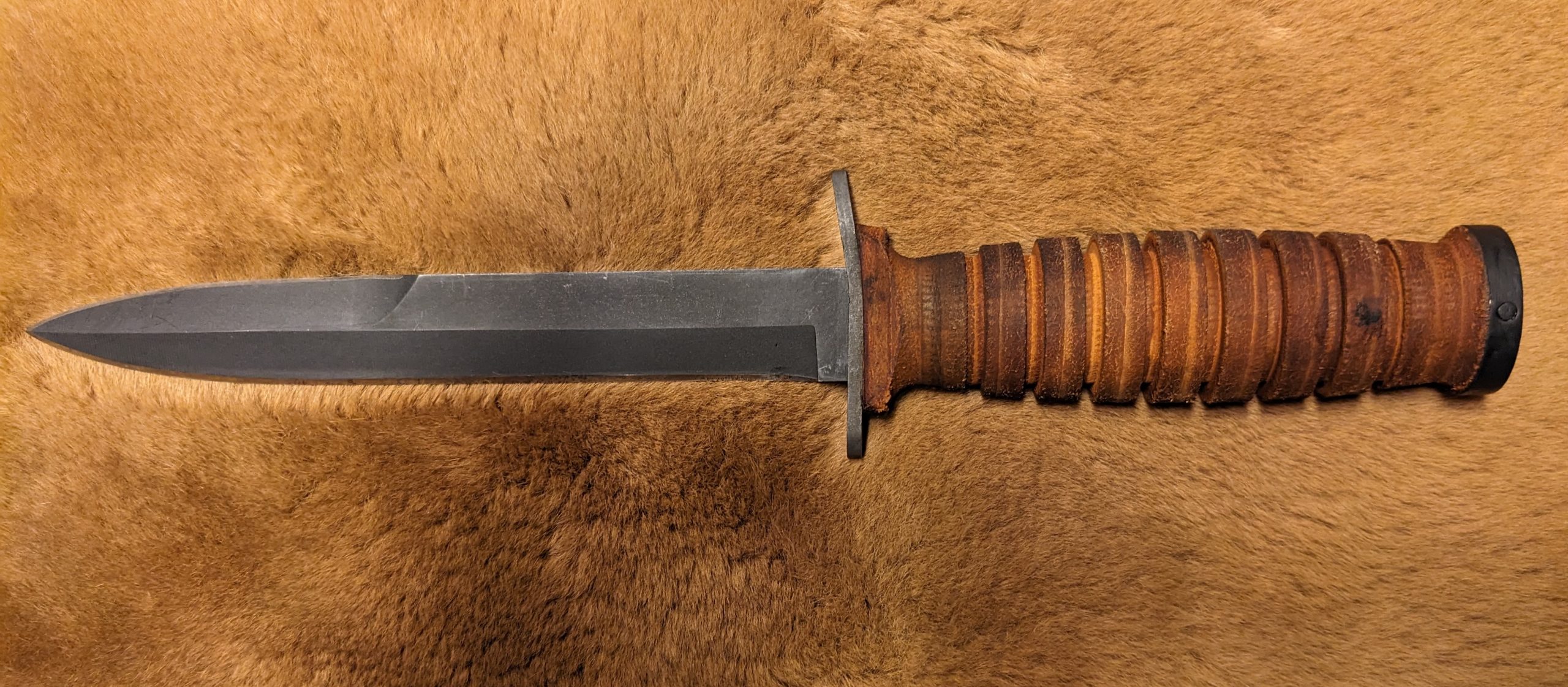
The M3 was first issued by the US military in March of 1943. It was designed to use few vital resources and to be easy to manufacture quickly in bulk. More than two-and-one-half-million were manufactured in 1943 and 1944. With the addition of a bayonet ring on the hilt and a locking mechanism on the pommel, the M3 became the M4 bayonet for the M1 Carbine. This made the original M3 redundant, and its production ceased.
 [7]
[7]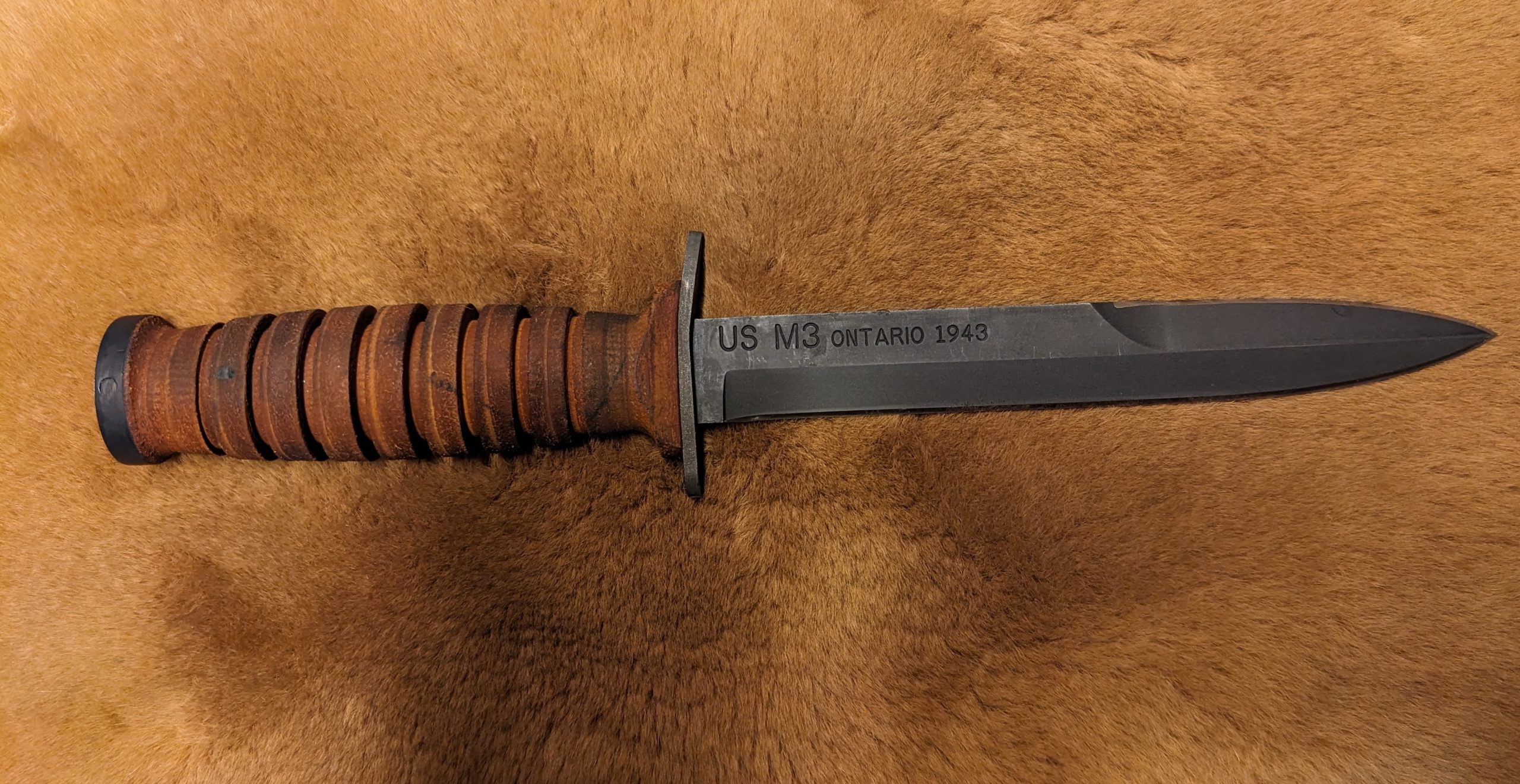 [8]The design of the M4 bayonet influenced the M5 bayonet for the M1 Garand, the M6 bayonet for the M14 rifle, and the M7 bayonet for the M16 rifle. This perpetuated a design that was great for killing, but poor for the more utilitarian tasks for which knives and bayonets are most often used. It was not until the adoption of the M9 bayonet in 1986 and the OKC-3S bayonet by the Marines in 2003 that the US military finally had truly utilitarian bayonets after more than 40 years of wandering in the cutlery wilderness.
Ontario Knife Company
The Ontario Knife Company (OKC) was established in 1889 in the city of Naples in Ontario County, New York. OKC has provided a wide variety of knives to the US military and civilian markets over the years, including the OKC 3S bayonet mentioned above, as well as the Old Hickory line of kitchen cutlery. Some of their models were produced overseas like their excellent RAT1 [9] and RAT2 [10] folding knives, I believe are still being produced in Taiwan.
The company was sold in 2023, and their ongoing status has been in doubt. Happily, they had a booth at SHOT Show 2025 [11]. I eagerly look forward to the time when the OKC website [12] will once again be able to process orders.
Conclusions
In Stephen Hunter’s novel, The Bullet Garden, Lieutenant James Leets drops an M3 while he is preparing a bridge for demolition on D-Day. Lieutenant Leets feels bad that he lost a good knife. After handling the M3, I went back and reread that part of the story. It just doesn’t ring true. I just can’t imagine a Minnesotan with practical field experience like Lieutenant Leets feeling all that bad about the loss of an M3 back before it had any historical significance. In fact, the records of the 100th Infantry Division suggest that most troops who were issued the knife lost or discarded it under the pressure of combat. The utility of the knife was too limited to make it worth carrying when an equal weight of ammo or other equipment would be far more useful. This was similar to the way that gas masks were quickly discarded by frontline troops in World War II when it became evident that gas attacks were unlikely.
The M3 ended up being a poor economic decision as well as a poor military decision. In addition to being frequently discarded for its lack of utility, the relatively flimsy blade was often broken when it was pressed into service for utilitarian tasks like prying open crates. Then the knife needed to be replaced. Although it cost less to produce one M3 than it cost to produce one more utilitarian design like the KA-BAR, it cost more to produce two M3s than it cost to produce one KA-BAR. Since the M3 was relatively flimsy and of limited utility, it was frequently discarded or broken. In contrast, the more sturdy and useful KA-BAR was better able to hold up to the demands of field use.
The M3 fighting knife is an interesting historical artifact as well as a cautionary tale. If we are not careful, we can become distracted by secondary considerations and equip ourselves with gear that will not serve us well under realistic field conditions. The selection of ineffective equipment can then be perpetuated for generations by tradition and inertia. Note the continued issue of the Glock 78 and 81 knives to the Austrian Army.
Practical field use is the best laboratory for gear effectiveness. The best gear is durable, reliable, and capable of a multitude of uses. I do not recommend utilizing the M3 fighting knife under field conditions. [JWR Adds: I generally concur. In the field, a sheath knife is used mostly for utility purposes. But I suppose that if I ever was going out specifically to stick someone, or stick some large animal, then I would carry a well-sharpened and purpose-made fighting knife such as the M3.]
On the other hand, there are people with expert knowledge who do not share my low opinion of the M3. For example, Congressional Medal of Honor recipient Paul Huff was wearing an M3 on his belt when he was awarded that medal by Lieutenant General Mark Clark on June 8, 1944. He won the award for his actions while leading a reconnaissance patrol. He left his men in a relatively secure location, traversed an enemy minefield under machine gun and mortar fire, killed an enemy machine gun crew, and returned with the intelligence necessary to subsequently overrun the enemy position. If a guy like that thinks that it is worthwhile hanging on to his M3, then maybe my opinion doesn’t count for much.
Disclaimer
SurvivalBlog Senior Editor JWR gave me an M3 Fighting Knife as a birthday present from the inventory of Elk Creek Company. I tried not to allow his kindness to interfere with my objectivity in this review. I also hope that my lukewarm evaluation of the M3 as an item of field gear are not perceived by anyone as lack of appreciation for a wonderful gift. I really am glad to have the knife. I just don’t plan to utilize it under field conditions.
I did not receive any other financial or other inducement to mention any vendor, product, or service in this article.