Have you ever thought about going off-grid in the tropics? No? Well, me neither, yet that’s where I find myself.
First up, though I have had food stores and access to water as a habit for over a decade I have only been living (mostly) off-grid for a year. So I’m not very experienced and still learning the ropes. But I thought my experiences here might be a curiosity and possibly be interesting reading for others.
I originally moved to Thailand to work in the action film industry, 21 years ago. Since then I saw that the country started modernising, Westernising and becoming more difficult to stay long term. To be honest, after seven years I had exhausted my career opportunities there. After a short stay to try Australia again, I decided to relocate to the Philippines to continue using South East Asia as a low-cost base from which to operate from. Visas are much easier here, and the culture is more in alignment with Western culture than any other country in South East Asia. And, as an expat, you do not submit tax forms nor pay tax on any overseas monies sent into the country. Though the people have a reputation for being generally nice and friendly it is still a poor, violent, and dangerous country. It is a lot better now than when I first arrived 14 years ago thankfully as I too have mellowed somewhat in that time.
After living in Bangkok then Manila for 17 of those 21 years polluted mega-city stresses built up and I decided that for my girl and my own sanity and health to escape the pollution in all it’s forms, such as the generally poor quality of formaldehyde-laced “fresh food” [1] and move away from the emerging neuvo riche middle class who prioritise ego, fake showings of wealth and materialism thinking this was modern success. New car and property repossessions tell a different story, but hey who cares about your economic future when you already got years worth of photos of “success” to post on your Facebook wall. The concept of “Face” is everything here, and easily exploited amongst the weak-minded.
In Manila, despite having a small yet well appointed house and a bunch of working class apartment rentals with a too comfortable retirement, my long- girlfriend and I decided to make plans for a nice proper retirement in a rural province away from all the modernisation, and far, far away from the potential of 15 million hungry Manila residents should any catastrophe befall Manila. This is something not unheard of in the most disaster-prone country in the world, even a really bad once-in-a-lifetime storm could flood the roads and take electricity, water and phones down for a week as has happened in several regional towns in the 14 years I have been here. Or, God forbid, if a regional war with China broke out and restricted shipping, since the Philippines relies heavily upon food imports.
So, we started looking for a secure, unpolluted place to grow our own unadulterated food, we made a list of wants and needs. We spent over a year of looking. Then we got a call from the first place we originally tried to make an offer on, and learned that it was now for sale. There are spring water creek on two sides of the property borders and a hill with a cliff face being the rear boundary. The farm is right near her home town.
My girlfriend’s mother had worked the land next door as a young woman which made the purchase secure as we knew we were buying from the rightful owner, since there are no hard land titles in this area we were buying squatter “rights” only. This is an area inundated with fraud. More accurately, all of the Philippines is inundated with fraud, so knowing the owners going back several generations certainly helped with peace of mind. To make it clear, you have to live on and utilise unclaimed land for 50 years here before you can apply for titles, then that takes a whole community to apply before anything gets done. Most of the land in this country is squatters rights, though that is starting to improve. Several Government departments still hold up the title applications and ask exorbitant “fees” to process them.
Yes, welcome to the Third World, but wait…. There’s more….
15 months ago, my girlfriend went down (32 hours on a bus) for two weeks to get the disused rice and coconut farm operational again. After two weeks she decided she wasn’t coming back to Manila. So, I too began the piece-by-piece move to one of the more remote provinces of the Philippines.
First up, if you have foreign funds or foreign income it is often very inexpensive to live here. This translates to all things including labour — which is an article in itself, suffice to say it’s not Western standards. Cheap except if you try buying quality imported goods or trying to live a Western lifestyle in which will end up more expensive than back home though you’ll have a much better or much worse quality of life depending upon your personal metrics.
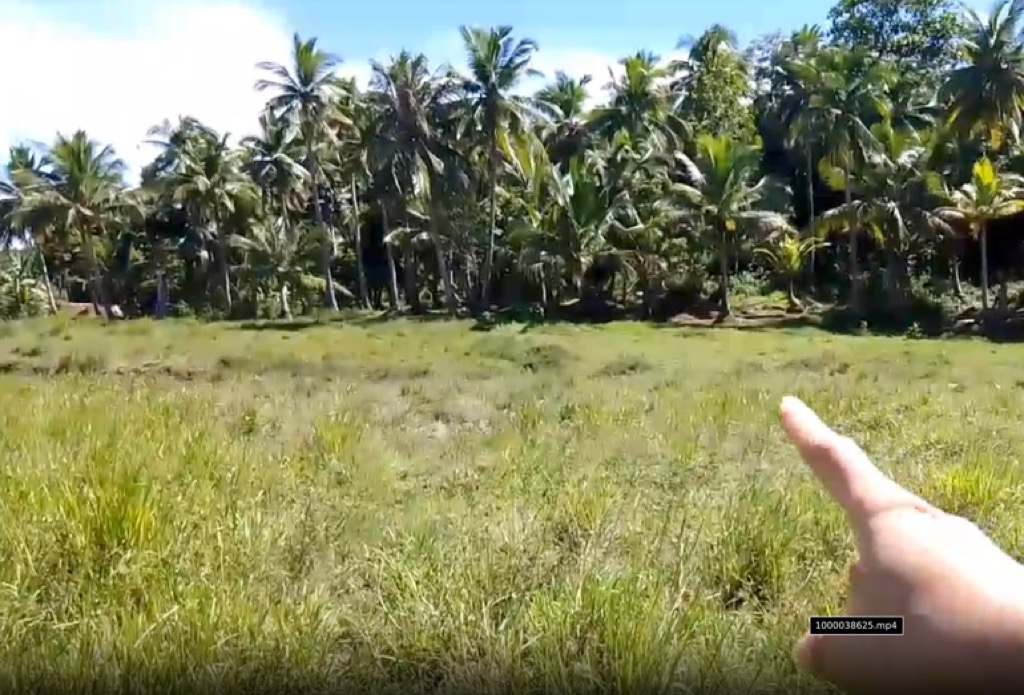
We ended up overpaying for a small, disused overgrown unimproved farm. One half of the land is coconut palm trees on the hill, and the other half is rice terraces.
 [2]
[2]
The disused, overgrown farm. I’m pointing to the future location of our house
We overpaid as the seller needed a certain amount and would not budge on price. As it ticked all our “needs” list and most of our “wants” list for a property, we said yes. I went down with wads of cash to inspect the property, then purchase it. My girl was very happy with it. But to say I was still rather uncertain would be an understatement. We were originally going to use it as a residential investment, as the nearby town grows in 10-20 years we’ll end up the wealthy land owners on the hill overlooking the town. Thus adding to our retirement funds, if we end up selling. That may happen in future but it’s not the way it is going now. We both love it here, or maybe more correctly we both hate the cities more after being here for a year.
The land cost us the equivalent of $8,500 for about a hectare (2.47 acres). We then got a skilled guy with a professional chainsaw to cut trees on the property by eye into 4×4, 4×2 and planks for sidings with the chainsaw. With the paid help of a couple of family members we then built a 30 sqm (323 sqft) wood cottage with tin roof for a total cost of USD $900. This was later expanded with an awning on two sides to 75 sqm (775 sq ft) under cover as the rain was often blowing sideways into the house. It still does, but to a lesser degree.
Yes, just $900 for an open-sided tropical house.
A fire extinguisher was the first item sent from Manila. A 2KW/2KWh AC200P Bluetti all-in-one solar power station, 1600W of solar panels, a 10m (34 foot) deep well to bedrock, a 30sqm raised chicken house, a 9 sqm storage shed, a simple toilet bowl into a makeshift septic, outdoor shower area, and some additional tools were also added for a final total cost of just under USD $5,000.
So all in, our investment was USD $13,000. I told you it was cheap here. Land taxes are laughable. I cannot remember exactly at the moment but they are under $15 USD per year.
Our finished “temporary” house can be seen at the top of this article.
Add in a total lack of building codes, inspections, or permits required it makes life easy here to build, add and modify or to just live how you want to, unmolested by bureaucrats. As in most of the developing world, you’re at risk of your own ineptitude and that is entirely upon you. A potential downside is that there is absolutely no way we can get house insurance where we are, but that is fine by me. The other downside is that most land here is untitled and therefore the banks won’t take them as security for a loan – also fine by me. We paid cash for all our properties.
We’ve already weathered two typhoons and came out with no damage besides the loss of the vegetable garden mainly due to building the house stronger than generally required and our choice of location with natural land barriers blunting the full force of the winds.
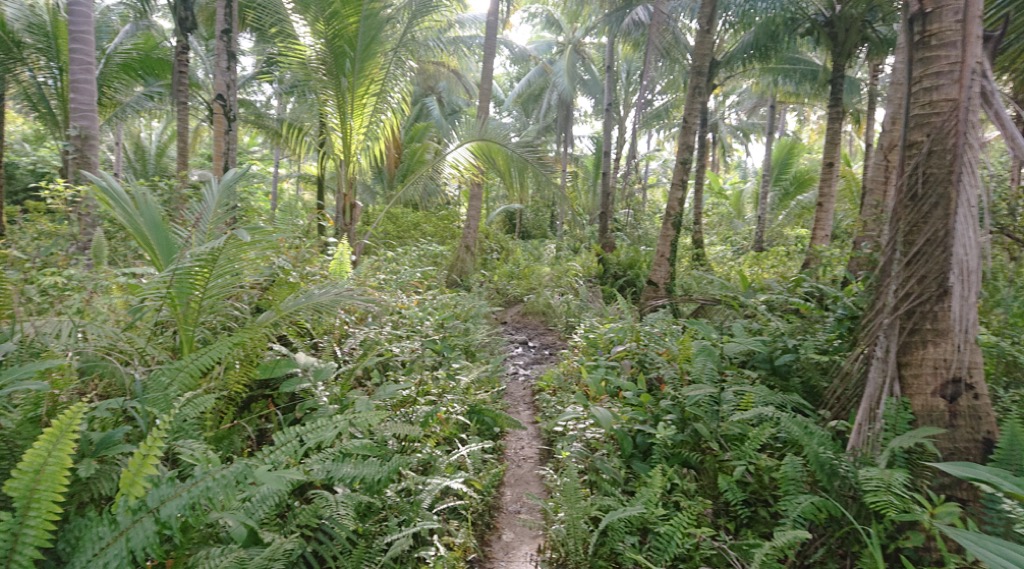
The property is a 15-minute trek to a road then 5 minutes along the road to the edge of the village for supplies in dry season. In the wet season we have to go the other way which is a 20-minutes slog through mud and jungle followed by another 20-minute walk into the village.
 [3]
[3]
The dry season jungle path to the road
Supplies are another issue. There is a general lack of everything and you often have little choice over what you get. The newly bought freezer from the town just 4 hours drive away for example there was one brand available in two sizes. When building the house we originally got green roofing sheet, that was not available again when we put the extensions on so it was plain roofing sheet, green roof paint was not available either, only red. Excellent –we’ll look like a tropical Santa Clauses’ house.
Even down to simple things like imported alcohol used to be available in limited quantities, there is now only one shop that has one brand of watered down for local tastes cheap bottom-of-the-barrel imported blended whiskey. you value your liver at all you do not want to drink the local alcohols. There are hot dogs, reconstituted “butter’, bread rolls, and caraboa (fully free range, organic, grass-fed water buffalo) available. But we don’t have access to beef or pork. Pretty much everything is hit-and-miss each time you go to buy.
After years of no online shopping available due to banditry, an increased army presence seems to have taken care of that and we did start to get online shopping deliveries for a few months with only smaller items (car battery size, or smaller) available. It has now become problematic again. (It seems corruption is to blame, now. But I do think that will be sorted out again sooner or later as will the size restrictions as the previous single lane highway to here has been improved to two lanes and currently in the process of being built out to 4 lanes, some areas even have sparse solar street lighting.
(To be concluded tomorrow, in Part 2.)