(Continued from Part 1. This concludes the article.)
Some Additional Notes
Here are some additional notes on the circuit design and practical use of the Franzi one-tube radio kit:
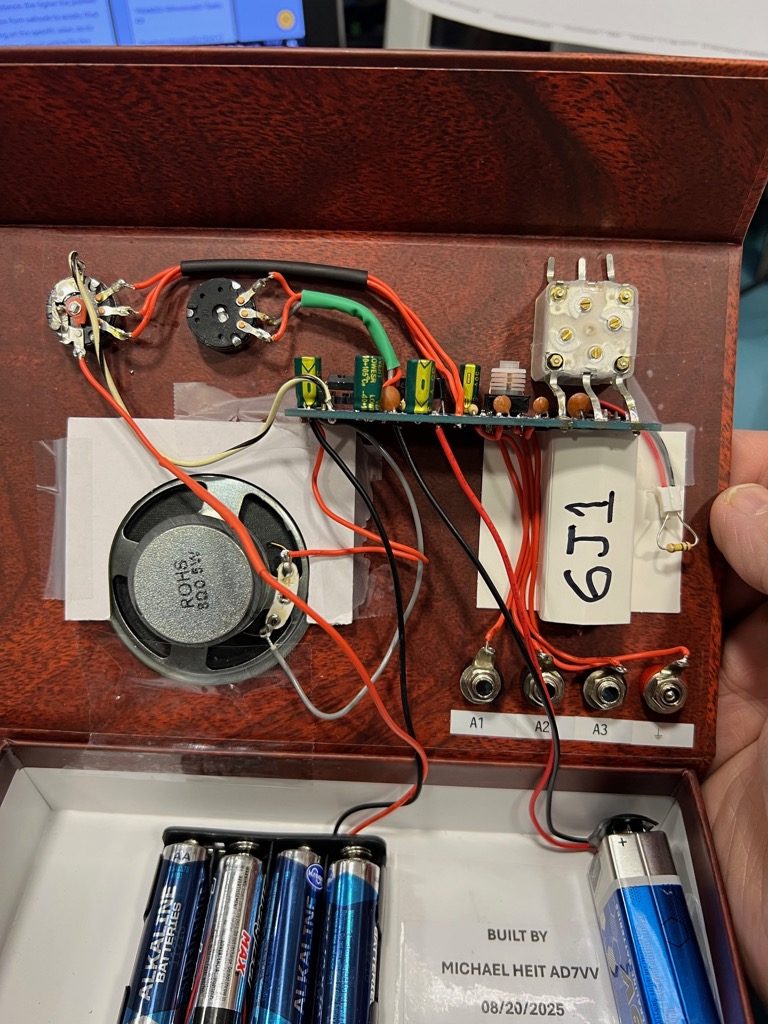
- First, it’s noticeable that this is a hybrid radio. It uses a 6J1 valve (tube), equivalent to the EF95 (also known as 6AK5), as a regenerative detector, followed by a transistor (T2) acting as a preamplifier, and then a power amplifier (the well-known LM386) to provide enough audio power to the speaker, It doesn’t include a headphone output, which is a downside, however a simple modification and a high impedance earphone could be used to must the speaker and use the headphones for listening.
- Two batteries are used: a 6V battery for the LM386, and a 9V battery which, combined with the 6V, gives a total anode supply of 15V—enough for the low-current 6J1 tube to operate.
- The transistor T1 acts as a simple switch, so when the 6V supply is turned off, it also disconnects the potentiometer P1, preventing unnecessary drain of the 9V battery, which is not switched off by the main power switch.
- Regarding the regenerative receiver stage, the feedback is controlled by P1, which simply adjusts the plate voltage to the 6J1, thereby controlling the feedback level. Although the 6J1 is a pentode, it is connected as a triode, which in turn is wired like a typical regenerative circuit with a center tap on the tuning coil—except for R1, which is connected to the anode to ensure a certain positive voltage on the control grid. This function is important, so the kit includes a small, dedicated socket for R1, allowing you to alternate between three possible resistor values (100K, 330K, or 1M). The lower the resistance, the higher the positive voltage generated on the control grid, which forces a greater flow of electrons from cathode to anode, thus affecting the regenerative stage’s operation.
- The best resistor value varies depending on the specific tube, as no two work exactly the same, hence the option to try different resistors to find the optimal setting for the receiver. I used a 100 K-ohm resistor which measured out at 97.6 K-ohms well withing the 10% value and found that it worked just fine for operating. A builder could keep spares on hand, depending on location or the possibility of changing their locations.
- Finally, there are three possible antenna connections: A1, A2, and A3. I must say that A1 is almost completely useless because connecting the antenna to the cathode kills all the circuit’s feedback. A2 and A3 are more useful, with A3 recommended for long antennas, as capacitor C1 compensates for part of the reactance that a long antenna might have. For testing with short indoor antennas, A2 has worked best for me.
- The frequency stability is very poor. If you get close to the antenna, the tuning changes. This is because the capacitance of the antenna changes when you bring your hand close. A similar effect happens when you bring your hand near the variable capacitor to adjust the tuning; just the capacitance added by a human hand is enough to change the tuning. This effect could be significantly reduced if the case were metal instead of cardboard, and if a transistor configured as a common-base stage were used in the antenna circuit to isolate the antenna from the tuning coil.
- The antenna coupling would improve if, instead of using a fixed-value capacitor like C1, a variable capacitor was used to finely adjust the antenna coupling with the tuning coil.
- The fact that the tuning knob acts directly on the variable capacitor does not allow fine frequency adjustment. This makes it quite difficult to tune stations that are close to each other (which is quite common in shortwave). A reduction drive system or even a small adjustable trimmer capacitor as a complement to the main capacitor would have been better to allow finer adjustment.
- The radio does not include a headphone output, which would be appreciated, especially to listen to weaker signals. It would also be useful to have the option to add an external power connector for an AC-to-DC power cube, or similar), since using batteries can drain them relatively quickly.
Overall, this kit performs well as a basic radio to teach the fundamentals of regenerative receivers and as an introduction to valve radios.
 [1]
[1]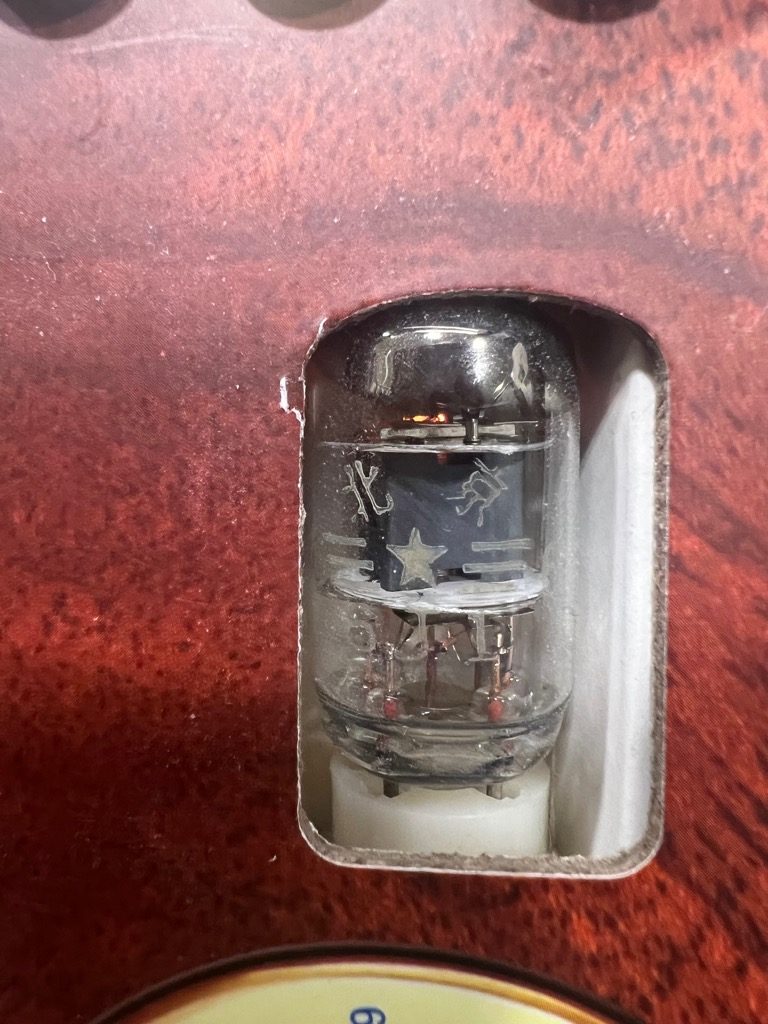 [2]I thought that tuning it up might be a problem, but this radio is a very sensitive receiver and my skillset in performing the tuning was quickly learned. So the radio was able to receive many shortwave stations without much fuss. I just threw a small gauge copper wire up into a tree and attached the ground wire to my house ground terminal, and off to the races we went. The volume from the LM386 audio amp is good enough for the speaker and if you modify the kit and add a socket and a set of headphones then it will work just fine and keep the signals heard privately.
Rechargeable batteries can be substituted for standard alkaline ones, and I plan to explore this later.
So, I can confirm that this kit is a good choice for anyone who wants a radio receiver that is sensitive to shortwave broadcast and the ham radio bands. It consumes very little power, and is light enough to carry in a pack. Once you get the hang of tuning it, you will find it a great option for emergency comms, and if you are a shortwave listener then you will enjoy the challenge of the “old days” form of shortwave listening. If you’re not a skilled builder I highly recommend you find a ham radio mentor to help you in the build process and gain some valuable experience that could come in very handy TEOTWAWKI.
There are many other radio options, and I intend to write additional articles, as fortune awards me. For those of you concerned about EMP, you are valid in your reasoning. The only parts that I would be worried about are transistors T1 and T2 (BC547 NPN type) and the op-amp LM386 an integrated circuit (IC) both the transistors can be mounted in a plug-in type socket for easy replacement if needed, and I did mount the IC in a plug-in base that I had on hand, for easy replacement. All three components are commonly available at such places as Jameco [3] as well as many other vendors. They are very inexpensive so you could stock up a fairly large number of them for future use and keep them all in a metal can or box to protect them from possible ESD (Electro-static Discharge) or EMP. A spare tube can be had as well for just a few dollars and will last a very long time.
This nostalgic kit builds a shortwave receiver with adjustable feedback. The principle of operation is inspired by the Audion tube from the early days of radio technology. Over a century ago (the 1920s), such a radio receiver could be found in many living rooms. The Audion was also used by amateur radio enthusiasts, in military communications, and in marine radio. The Audion is an electronic detecting or amplifying vacuum tube invented by American electrical engineer Lee de Forest as a diode in 1906. That was 119 years ago. Some things just never go out of date or out of style.
De Forest’s remarkable invention marked a major transition point in the history of electronics. When he inserted a small, coiled grid into the center of an ordinary vacuum tube, it paved the way for the future of telephone, radio, television, and computing. What he did then was relatively simple by today’s standards. He found that by regulating the voltage that went into the grid he could boost the amount of current flowing through the tube. That meant, instead of having a telephone signal fade out after just 1,200 miles, Audions could be set up across the country, and boost the audio signal enough to go from coast to coast, over 3,000 miles.
Audion vacuum tubes would continue to be used in radios until the early 1950s. That’s when new technology would take hold, making radios lighter, smaller, and more portable. This new technology changed the world of electronics once again, and today, almost any audio or visual electronic device we use relies on this electronic wonder. However fantastic the new technology is, the simple fact that an electron vacuum tube is very highly resistant to EMP damage makes them a good investment in a grid down situation for reliable communications.
So, you might just want to consider a tube-type radio that can be powered by a rechargeable type of battery supply and a simple wire in the tree antenna and have some assurance that you can be able to get some information in a time of crisis even if “they” consider doing such activity to be nefarious and punishable. Like I said earlier, all “they” need is a 7.62 NATO enema to clear up their thinking.
In closing, I should mention that the soft, warm glow of the tube in my radio is comforting on a winter’s night.